
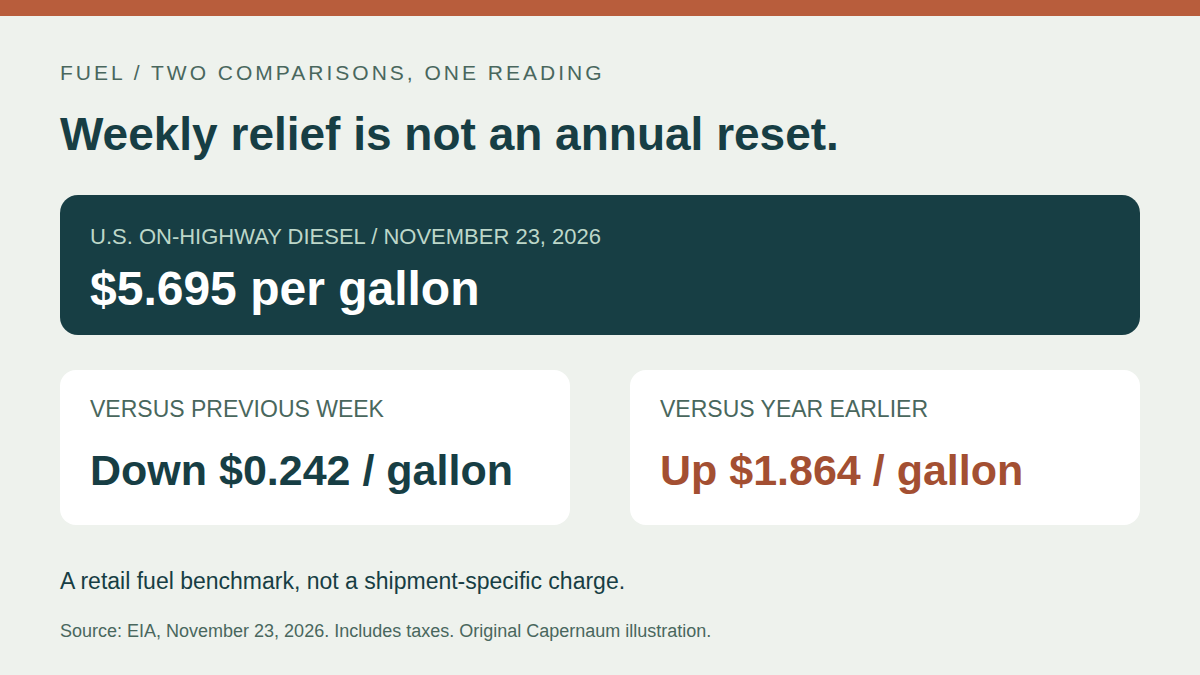
The latest EIA weekly diesel prices show relief from the previous week, but not a return to last year's cost level. The U.S. Energy Information Administration's November 23, 2026 reading puts the U.S. on-highway diesel average at $5.695 per gallon, down $0.242 from November 16. The same table places it $1.864 above a year earlier. For shippers reviewing transportation budgets, those two comparisons answer different questions.
A weekly decline and a higher annual comparison
The national average was $5.937 on November 16 and $5.695 on November 23. That is a 24.2-cent weekly decline. EIA's year-ago comparison remains positive, however. A lower reading this week does not mean the benchmark is below the corresponding week last year.
These are published retail fuel averages in dollars per gallon, including taxes. They are not truckload or LTL freight rates, a quote for a particular lane, or a Capernaum fuel-surcharge schedule. The observation date is November 23, not this article's November 26 publication date.
The Central Atlantic reading adds a second budget check
For the Central Atlantic region, EIA reports $6.146 per gallon on November 23, down $0.163 from the previous week and up $2.136 from a year earlier. Its weekly direction matches the national decline, but the reported price level and changes are different.
For a New Jersey-area shipper, our recommendation is to record the benchmark actually named in the freight agreement rather than substitute whichever regional or national figure appears in a headline. A regional retail average does not establish what a particular carrier paid or what a particular customer owes.
Separate the budget comparison from the shipment charge
A useful review can keep three fields side by side: the November 23 benchmark, the comparison period used in the budget, and the fuel-related terms in the actual quote or agreement. Label each field explicitly. That avoids describing a weekly improvement as an annual reduction, or treating a pump-price change as a matching change in the total freight bill.
- Confirm the reference date. Ask which published observation the quoted fuel component uses and when any update takes effect.
- Confirm the geographic series. Record whether the agreement refers to a national benchmark, a regional series or another stated basis. Do not change the reference unilaterally.
- Read the quoted charge. Check the actual calculation or schedule provided for the shipment. This article does not calculate an applicable surcharge.
- Keep the rest of the move comparable. When comparing quotes, hold the lane, equipment and agreed handling scope constant before attributing a total-price difference to fuel.
These are Capernaum's operational review suggestions, not new EIA requirements or a prediction of freight prices. For an imported container followed by a regional delivery, ask about each quoted leg instead of assuming one headline movement changes every component in the same way.
What this reading does not establish
The weekly table alone does not show available truck capacity, a shipper's negotiated rates, or how the next observation will move. Nor does it establish why diesel prices changed. We are not projecting any of those outcomes from this release.
Trucking Dive's industry data hub, updated November 25, also tracks diesel alongside other trucking indicators. We use EIA directly for every numerical statement here; the publisher's dashboard is additional industry context, not a substitute for the primary table.
For the underlying distinction between a retail benchmark and a shipment invoice, see diesel prices versus the freight bill. To discuss a specific drayage, regional or FTL/LTL movement, send Capernaum the shipment details. No rate, savings, capacity or surcharge commitment is made in this article.
Sources and timing
Primary source: EIA Gasoline and Diesel Fuel Update, observation dated November 23, 2026 (2026-11-23), checked November 26, 2026. Numerical claims above use the U.S. and Central Atlantic rows of the on-highway diesel table, not the gasoline table. Independent context: Trucking Dive data hub, shown updated November 25, 2026. This is original desk analysis of public sources, with no interviews or personal field reporting implied. The original illustration summarizes the national comparisons and is not a market forecast.