
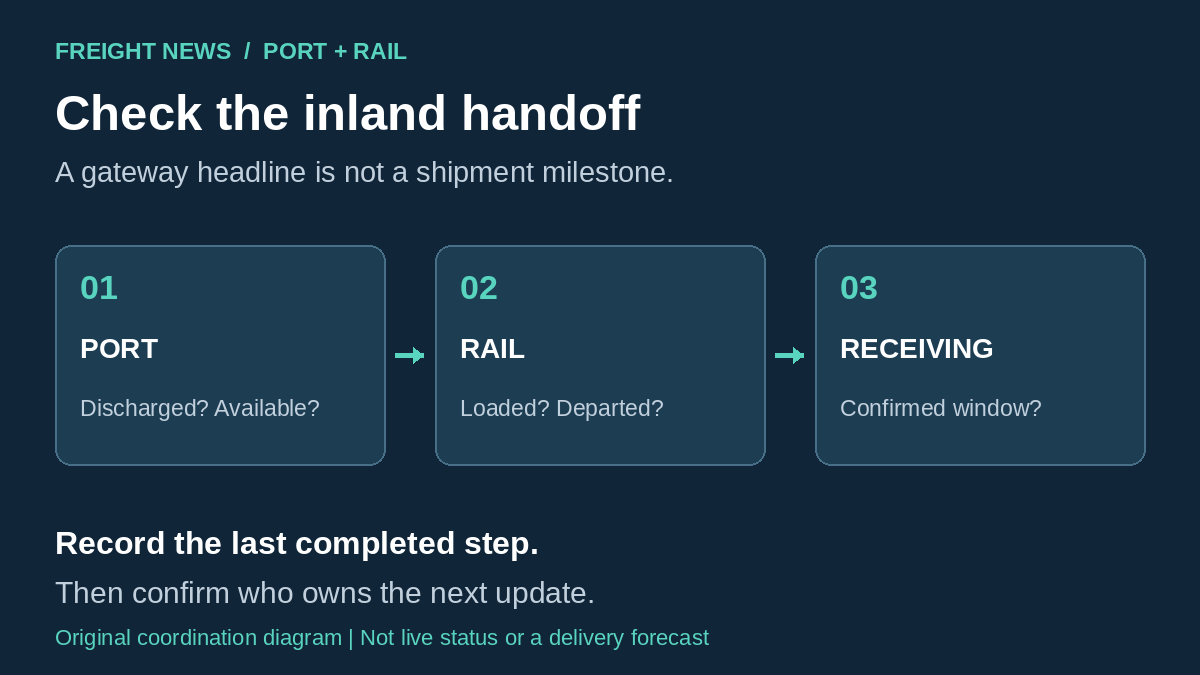
The Los Angeles-Long Beach rail backlog is a reason to check the inland handoff on an import shipment, not to assume every container at the gateway is stalled. FreightWaves reported on October 28 that 35,688 import containers were awaiting on-dock trains on October 26. For a U.S. shipper, the immediate question is whether a delivery commitment rests on an estimated rail departure or a confirmed movement.
What the latest report establishes
FreightWaves' October 28 report, citing The Dwell's compilation of the ports' daily rail reports, says 10,562 of those containers had been on terminals for at least nine days. The inventory counts containers, not twenty-foot-equivalent units. It is a dated snapshot of cargo awaiting rail service, not an average delay and not evidence that every listed container is overdue.
The same report cites Pacific Merchant Shipping Association data showing September average rail-container dwell of 7.19 days, compared with 6.75 days in August. Average local-truck dwell was 3.18 days in September. These monthly averages and the October 26 inventory describe different measures and different periods. They should not be combined into a forecast for a particular box.
FreightWaves also published responses from Union Pacific and the Port of Long Beach. Union Pacific said it continued pulling cargo from the docks and using its Intermodal Container Transfer Facility to support fluidity. Long Beach described longer delays at some smaller inland rail hubs than at major destinations. Those responses reinforce why a gateway-wide headline cannot establish the status of a specific destination or booking.
Find the next confirmed milestone
An arrival notice is not confirmation that the inland connection is complete. Ask the responsible provider to identify the shipment's current location and the last completed milestone. Separate vessel discharge, terminal availability, rail loading, train departure and destination-ramp availability on the shipment record.
- For freight still awaiting rail: request the latest equipment status and the next update time. Keep an estimated departure visibly separate from an actual departure.
- For freight already moving inland: check the destination ramp, the provider's current availability estimate and who will confirm pickup readiness.
- For the receiving warehouse: identify which appointment depends on cargo becoming available, and when that appointment can be changed without disrupting the next delivery.
These are coordination checks, not a claim that the railroads or terminals use identical release procedures. Use the instructions for the actual terminal, railroad and shipment.
Compare an alternative only after checking release and receiving
A rail backlog does not automatically make local drayage followed by transloading the better option. Before requesting an alternative inland plan, ask whether the container can be released for that movement and what approvals or booking changes are needed. Do not send a truck on the assumption that a rail-designated box is available for road pickup.
If an alternative is feasible, compare the complete movement: pickup eligibility, terminal appointment, equipment, transload receiving window, cargo handling requirements, onward truck transport and final delivery appointment. Ask providers to identify applicable storage, handling and equipment terms rather than treating a linehaul quote as the full cost.
No shipment-specific price, capacity commitment or time saving is established by the report. If the original route remains the better fit, the practical response may be a revised receiving plan and clearer milestone updates rather than a mode change.
Keep the scope of the warning clear
The reported rail inventory does not establish a comparable truck-side backlog or a shutdown of both ports. Nor does it show that an East Coast gateway or an unrelated lane has the same conditions. For background on the local container leg, see our guide to drayage.
For an upcoming container pickup or regional delivery, contact Capernaum with the origin, destination, cargo, availability status and receiving requirements. Confirm the shipment-specific scope and feasibility before changing the transport plan.
Source and editorial scope
Source: FreightWaves, published 2026-10-28 and updated the same day; inventory observation 2026-10-26, monthly dwell observations August and September 2026. Checked October 28. The figures and provider responses above are attributed to that reporting; Capernaum has not independently audited the underlying daily inventory. This is original operational analysis of published reporting, not an on-site investigation, a delivery forecast or a statement of guaranteed capacity. The featured illustration is an original conceptual diagram, not live tracking data.