
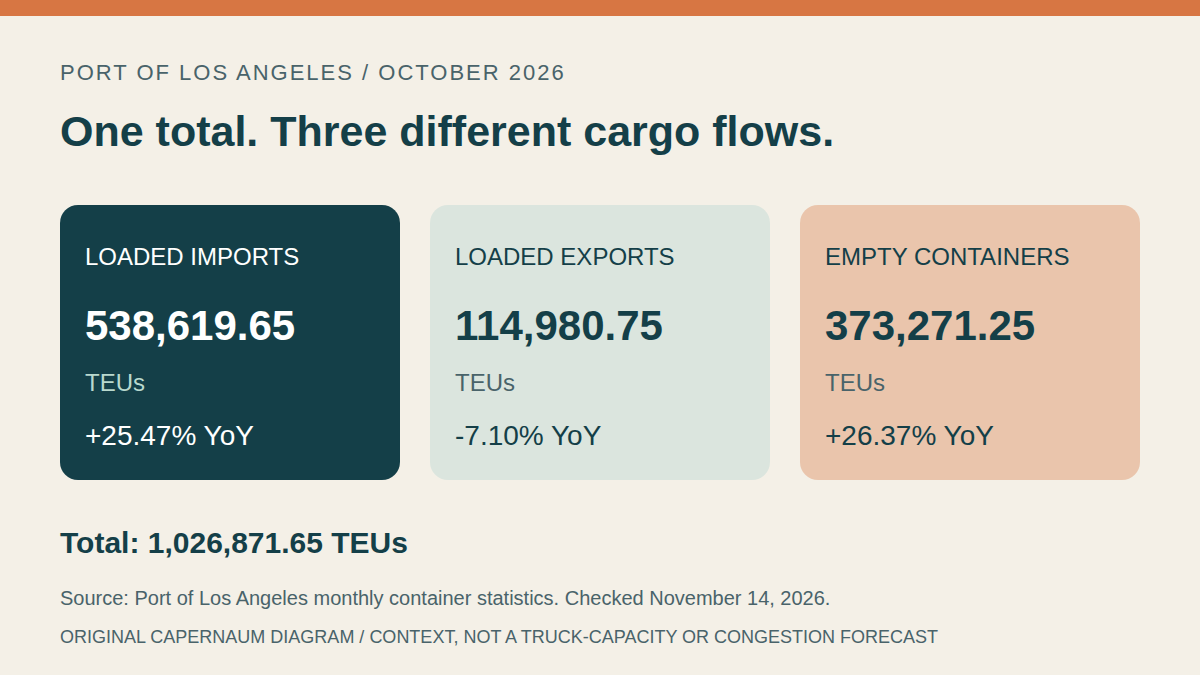
Port of Los Angeles container volume rose in October, but the mix matters as much as the headline total. The port’s published statistics show 1,026,871.65 twenty-foot equivalent units (TEUs), up 21.03% from October 2025. Loaded imports, loaded exports and empty equipment moved in different directions. For shippers arranging an inland handoff, that is a reason to separate the cargo flows rather than treat one port-wide number as a dispatch forecast.
Three flows behind the October total
The Port of Los Angeles monthly container statistics list loaded imports of 538,619.65 TEUs, up 25.47% year over year. Loaded exports were 114,980.75 TEUs, down 7.10%. Empty containers accounted for 373,271.25 TEUs, up 26.37%. Together, those three categories make up the reported total.
FreightWaves reported the October results on November 13, 2026, rounding total volume to 1,026,872 TEUs. Its rounded import, export and empty figures align with the port’s underlying table. We use the port’s precise figures here and credit the Port of Los Angeles as the data source.
TEUs are a standardized measure for containers of different lengths, as the port explains. A TEU count is not a count of inland truck appointments, individual orders or available vehicles. Nor should empty-equipment volume be read as additional loaded merchandise ready for delivery.
Why the mix matters to an inland shipment
An import delivery, an export pickup and an empty-container return are different coordination tasks. The monthly result describes activity across the port. It does not tell an individual shipper whether a specific container is released, whether an appointment is confirmed or whether a receiving warehouse can accept the load.
Our recommendation is to use the report as context, then build the movement plan from shipment-specific confirmations. Do not turn an increase in aggregate volume into an unsupported statement that every terminal is congested. Equally, a monthly total cannot establish that an individual pickup will be trouble-free. This article makes no claim about current gate queues, terminal dwell, drayage pricing or available capacity.
Match the planning questions to the cargo flow
- Loaded import: Ask the responsible parties to confirm the container reference, terminal, release status and pickup requirements. Coordinate the onward delivery with the actual receiving location and its confirmed appointment.
- Loaded export: Confirm the booking and the relevant receiving instructions with the responsible provider. Keep the cargo-ready plan and the accepted handoff timing together rather than borrowing assumptions from an import move.
- Empty equipment: Obtain the current authorized return instructions for that equipment. Record the destination and any required confirmation separately from the loaded delivery. The port’s empty-container total does not identify an acceptable return location for a particular box.
- Any inland move: Share the cargo description, weight, packed dimensions, timing and handling requirements. Identify who will resolve a missing confirmation before treating the next step as ready.
These are original coordination recommendations, not terminal instructions, carrier terms or a universal release procedure. The actual shipment’s providers and receiving parties must confirm the applicable requirements.
A useful check before booking the next handoff
Suppose a hypothetical importer sees the higher October total and brings forward a warehouse delivery request. The useful next action is not to infer an earlier pickup from the port’s monthly performance. It is to verify the shipment’s readiness and align the terminal pickup with an accepted receiving window. The scenario illustrates a planning distinction; it is not a customer case or a claim that the report caused any shipper to change its schedule.
The same discipline applies to export and empty-equipment moves: identify the movement, obtain the relevant instructions and confirm the next handoff. Our drayage explainer provides background on the short-haul connection between a port and the inland journey. To discuss freight with Capernaum, share the lane, cargo, timing and known receiving requirements. No Port of Los Angeles affiliation, guaranteed service, rate or capacity is implied.
Sources and reporting scope
Published November 14, 2026. FreightWaves published its report on 2026-11-13 at 14:08 UTC. The port’s October 2026 statistics and the independent report were directly checked November 14. The rolling statistics page does not display an exact release timestamp; October 2026 is the data period, not an invented release date. Primary verification covers the total, component volumes and year-over-year comparisons. We omit claims about record rankings, causes and rail dwell that are not established by the checked monthly table. Recommendations and artwork are original. No publisher photography, charts or prose are reproduced, and no interviews or personal reporting are claimed.