
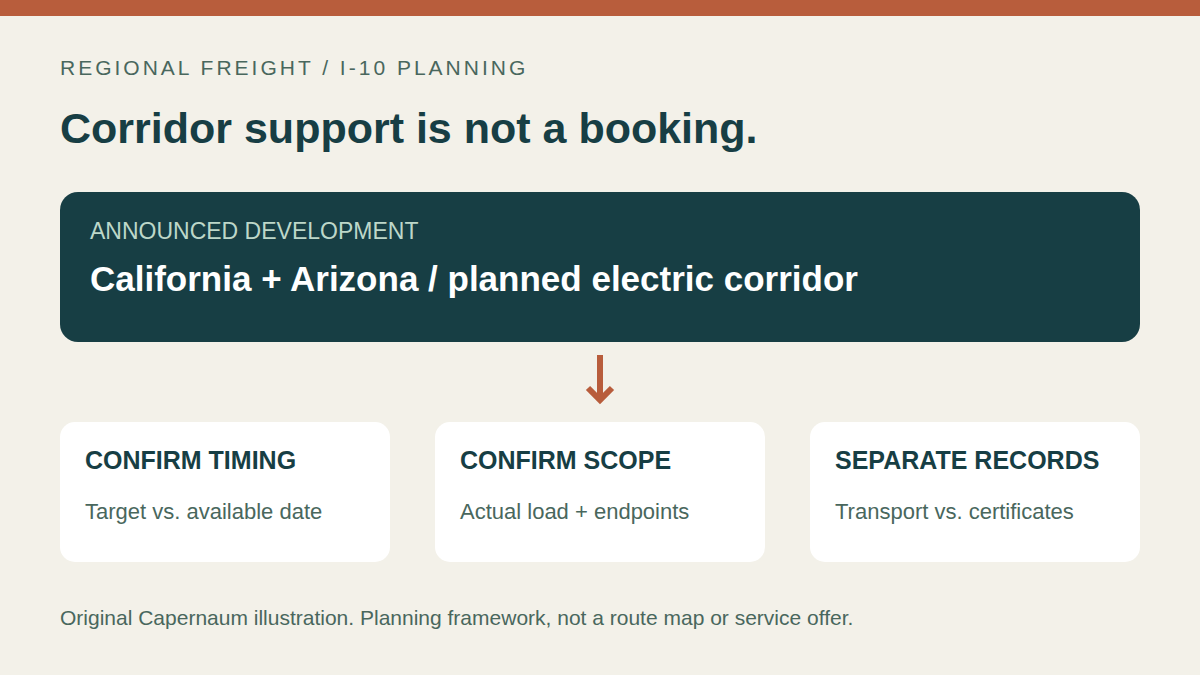
A planned I-10 electric truck corridor is a reason to ask more precise lane questions, not to assume a new service is already available. Nevoya is developing a California-Arizona route with support from Meta. The useful distinction for a shipper is between financing environmental attributes and confirming the truck, charging plan and operating dates for an actual load.
What has been announced
Trucking Dive reported on November 18, 2026 that the planned corridor connects San Bernardino, California, and Phoenix, Arizona. Its account describes an expected 2027 start with 25 trucks, citing a November 12 company announcement. Those are plans reported by the publisher, not confirmation of service operating today.
Meta's November 12, 2026 announcement independently confirms that it is expanding its work with Nevoya to a California-Arizona I-10 route. Meta says the initiative supports heavy-duty electric trucks and dedicated charging infrastructure, with permanent open-access charging stations intended to serve other commercial fleets. That confirms the partnership and corridor direction; it does not establish a shipper's booking terms.
Trucking Dive also reports that the I-10 route would develop later in 2027 as charging comes online, and that a charging infrastructure partner was still being developed when the publisher reported. This article does not independently establish a completed charging network or a final launch date.
Certificate support is different from a shipment assignment
Meta describes its purchase commitments as environmental attribute certificate agreements: a supplier provides lower-carbon materials or services, Meta pays for the environmental benefit, and the material or service is used in the local market. Trucking Dive reports that the Nevoya agreement does not involve moving Meta's own goods.
For a freight team, the operational takeaway is narrow. An announced buyer's support for a corridor does not identify whose cargo will move on an individual truck. Nor does it demonstrate that any particular shipment can claim an environmental benefit. Keep shipment instructions separate from any certificate purchase, allocation or reporting documentation. This is an information-handoff recommendation, not an emissions-accounting determination.
Five questions before changing a lane plan
Our practical recommendation is to turn the announcement into a short verification brief rather than change an existing routing guide immediately:
- Exact endpoints: confirm the pickup and delivery addresses, not just the two metropolitan areas. Ask whether either end requires a separate local transfer.
- Operating date: request a confirmed first available service date for the specific lane. Record whether the answer is a target, a trial or a bookable movement.
- Shipment fit: provide the commodity, packed dimensions, weight, handling requirements and receiving window. Obtain an explicit acceptance rather than infer suitability from the corridor announcement.
- Execution and contingency: ask who will confirm dispatch, report exceptions and arrange an agreed alternative if a scheduled movement cannot proceed. Do not assume the announcement includes a substitute truck.
- Separate documentation: distinguish the transport quote and shipment confirmation from any environmental certificate agreement. Identify the responsible contact for each.
Keep the ocean, regional and final delivery legs distinct
For an importer using Southern California gateways, an inland corridor announcement is not evidence that port pickup, container return, transloading or delivery at a particular receiver is included. If a proposed movement combines those activities, list each leg and the party accepting it before treating the plan as complete.
Use the same discipline when discussing Capernaum's freight coordination services: describe the actual freight and requested handoffs, then verify the available arrangement. Capernaum is not identified here as a participant in the Nevoya-Meta agreement, and this article does not offer capacity on that corridor.
Bottom line: the announced investment points to a planned regional option worth monitoring. The immediate shipper action is to verify scope and timing, not to treat a future corridor or certificate commitment as a current shipment confirmation.
Source and editorial notes
News development: November 2026 partnership expansion. Independent reporting: Trucking Dive, published November 18, 2026. Primary corroboration: Meta, November 12, 2026. Both references checked November 27, 2026. The linked November 12 wire release was unavailable to this review; no inaccessible text or imagery was used. Dates, truck count and rollout sequencing above are attributed to the accessible publisher. Operational questions are original desk analysis, not interviews, a service guarantee or specialized environmental advice. Original illustration shows the distinction between planned corridor support and shipment confirmation; it is not a route map.