
PAMT’s third-quarter results offer a useful reminder for freight quote reviews: a fuel surcharge has timing as well as a value. Trucking Dive reported on November 9 that the carrier’s parent posted a roughly $5 million operating loss for Q3 2026, even as its rate per mile improved year over year. The operational takeaway is not a market-wide rate forecast. It is a reason to check how a particular shipment’s fuel adjustment is defined.
What the reporting says
Trucking Dive attributes the results and management comments to PAMT’s earnings announcement. Its account says the company’s rate per mile improved 6% year over year, while higher fuel, driver retention and recruiting costs weighed on the quarter. These are company-specific reported results, not a quote for an available truck or an industry-wide pricing measure.
The report also attributes higher net fuel costs partly to a timing mismatch: national diesel prices were changing before the corresponding adjustments to customer fuel surcharges. It describes those adjustments as typically lagging fuel-price changes by a week or more in the company’s account. That observation does not establish the calculation or lag in any other shipper’s agreement.
Separate the base rate from the adjustment clock
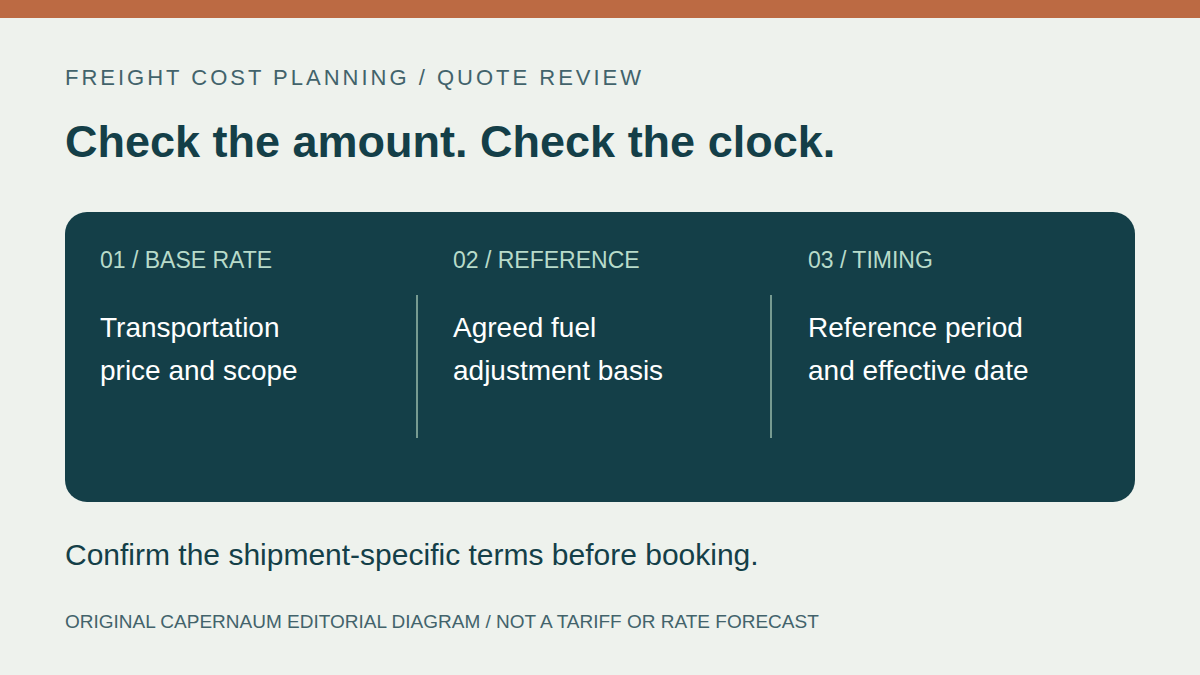
Our recommendation for shippers is to review three fields separately: the base transportation price, the fuel reference or other agreed basis, and the timing used to apply an adjustment. A quoted total without those details may leave the parties comparing different assumptions. Ask for clarification instead of filling in a familiar formula from another carrier or shipment.
For example, two hypothetical proposals could display the same base transportation charge but use different reference periods or effective dates for fuel adjustments. That is an illustration of what to ask, not evidence that any specific PAMT customer was quoted on that basis. No sample surcharge, rate or savings claim is supplied here.
A practical fuel-term review for the booking brief
- Identify the move: Keep the origin, destination, service scope and shipment timing attached to the proposal being reviewed.
- Separate the components: Ask which amount is the base transportation price and which items are additional. Do not assume fuel is included or excluded.
- Name the reference: If a fuel adjustment applies, ask for the agreed benchmark, geography or other calculation basis. Record the provider’s answer.
- Check the clock: Ask which reference period and effective date apply, when updates occur, and what shipment milestone determines the applicable adjustment.
- Retain the confirmation: Keep the accepted proposal and any clarified terms with the shipment record. Resolve a mismatch with the provider before treating two totals as directly comparable.
This is an original coordination checklist, not a description of PAMT’s contracting process, a legal interpretation or a universal fuel surcharge rule. The governing shipment terms must be confirmed with the actual provider. A public diesel benchmark alone does not establish the amount payable on a specific shipment.
Do not turn one carrier’s quarter into a market promise
The reported loss and rate improvement do not establish current lane capacity, a nationwide rate change or a service disruption. We make no prediction about PAMT’s financial outlook or any shipper’s future costs. A historical quarterly operating result and a shipment-specific commercial offer answer different questions.
For the broader distinction between a public fuel reading and a freight charge, see why a diesel price is not your freight bill. To discuss a move with Capernaum, share the cargo, origin, destination and timing. No affiliation with PAMT, customer relationship, guaranteed capacity or special pricing is implied.
Source and reporting scope
Published November 13, 2026. Source: Trucking Dive’s report published November 9, 2026 (2026-11-09), directly checked November 13. The financial figures and management explanation above are attributed to that accessible independent publication. The linked SEC earnings exhibit returned an automated-access restriction, and the checked company investor page did not expose the release text. Direct primary corroboration was therefore not obtained. We omit specialized regulatory explanations, unsupported market conclusions and the source image caption’s inconsistent quarter reference. No interviews or personal reporting are claimed. Article wording, recommendations and artwork are original; no publisher prose, photography or charts are reproduced.