
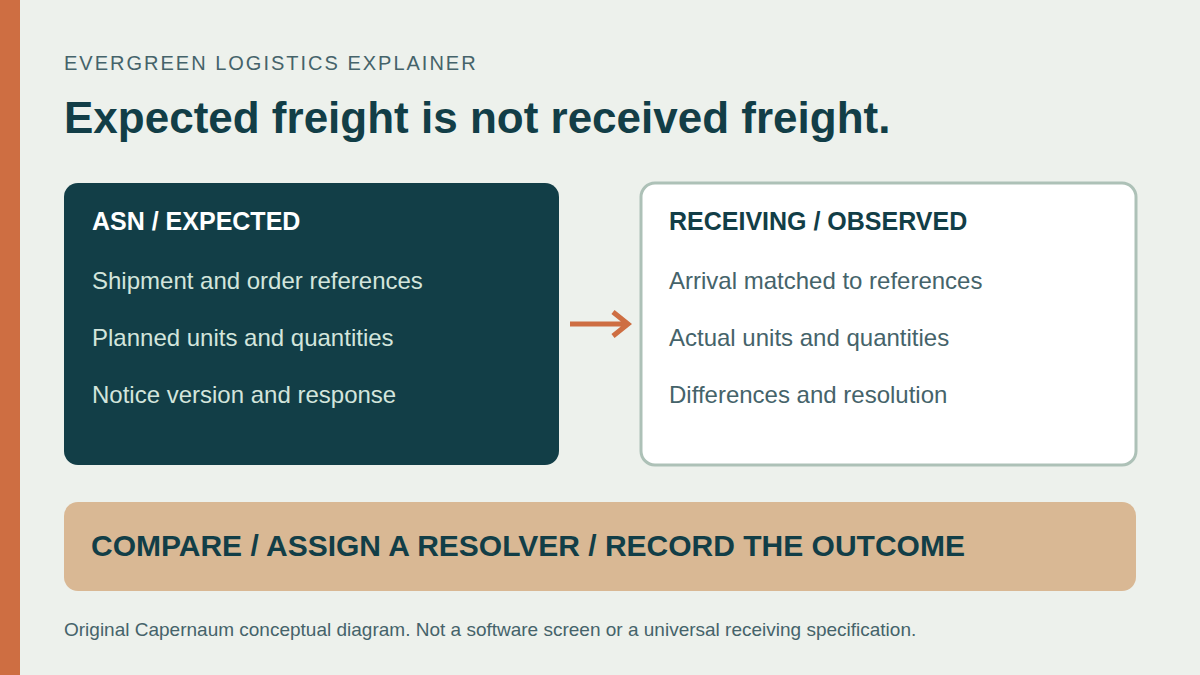
Evergreen logistics explainer. An advance shipping notice, or ASN, describes an incoming shipment so the receiving team can prepare. It is a statement about what to expect, not a substitute for recording what actually arrives. For U.S. shippers coordinating a warehouse delivery, the useful question is not simply whether an ASN was sent. It is whether the receiver can connect the notice to this load and reconcile the arrival against it.
What an advance shipping notice tells the warehouse
Microsoft's inbound ASN documentation explains that notices describe vendor deliveries, including shipment contents, items and packaging. They can help warehouse workers prepare and match a shipment with a purchase order or inbound shipment order. Those are useful planning functions. They do not remove the need to check the physical delivery.
Microsoft's examples distinguish shipment headers, packing structures, cases and item quantities. The practical lesson is to preserve those relationships: a list of products alone does not explain which products are on which handling units. Actual receiving formats depend on the warehouse and its trading-partner agreement; an ASN is not one universal form that every facility accepts.
Keep three different acknowledgements separate
The following distinctions are our operational recommendations, not a claim about every warehouse software system:
- Notice submitted: the sender has transmitted the expected shipment information.
- Notice usable: the intended receiver has confirmed that it can identify and use the record, or has resolved the reported errors.
- Goods received: the receiving team has recorded the physical arrival and any differences under its own process.
Do not turn the first state into the third on an internal status board. Similarly, receiving a notice does not by itself confirm a dock appointment, transportation booking or unloading arrangement. Obtain those confirmations separately from the party responsible.
Build a short expected-arrival record
Before dispatch, ask the receiver which fields and submission route it requires. As a working checklist, connect the notice reference and order reference to the destination, shipment reference, expected handling units, item quantities and units of measure. Identify the person who will resolve a rejected or unmatched notice. Keep the warehouse's response with the shipment record rather than relying on a verbal assumption that someone has seen it.
Where the trading partners use GS1 logistics labels, the GS1 Logistic Label Guideline explains how scanning a logistics unit's SSCC can link its physical movement to the electronic messages referring to it. This is a link between a physical unit and data, not a reason to assume the expected contents have already been verified. For the identifier distinction, see our guide to product identity and pallet identity.
Reconcile differences without rewriting the expectation
Illustrative example, not a customer shipment: a notice describes six pallets. At the receiving point, the team records five pallets and one unidentified unit. Marking the notice “received” without further detail would hide the unresolved comparison. A clearer record preserves the six-pallet expectation, records the observed arrival and assigns the unidentified unit to a named resolver. Do not decide from that comparison alone whether goods are missing, mislabeled or on another movement.
Our recommendation is to keep expected and observed quantities in separate fields, with the unit of measure stated in both. Record the time, location and person making the observation, then link the final resolution. If the sender corrects the notice, preserve which version the warehouse used. Follow the receiver's agreed exception process; this explainer does not determine liability, claims deadlines or acceptance terms.
Use the notice as a handoff, not a completion signal
An effective ASN handoff ends with a receiver who knows what is expected and how to match it to the arriving freight. Delivery completion still needs its own evidence. When discussing an LTL, truckload or warehouse delivery with Capernaum Transport, include the receiving facility's notice requirements alongside the physical delivery instructions. Do not assume a particular electronic integration or warehouse workflow is included in a transport quote.
References and scope
References checked November 16, 2026 (2026-11-16): Microsoft Learn, Import inbound ASNs through data entities, documentation dated May 5, 2026, supports the notice's contents and warehouse-planning role; GS1, Logistic Label Guideline, section 1.2.1, supports linking physical units to electronic messages. The three-state handoff and reconciliation checklist are original operational analysis. This evergreen article reports no new event, current market reading or Capernaum software capability.