
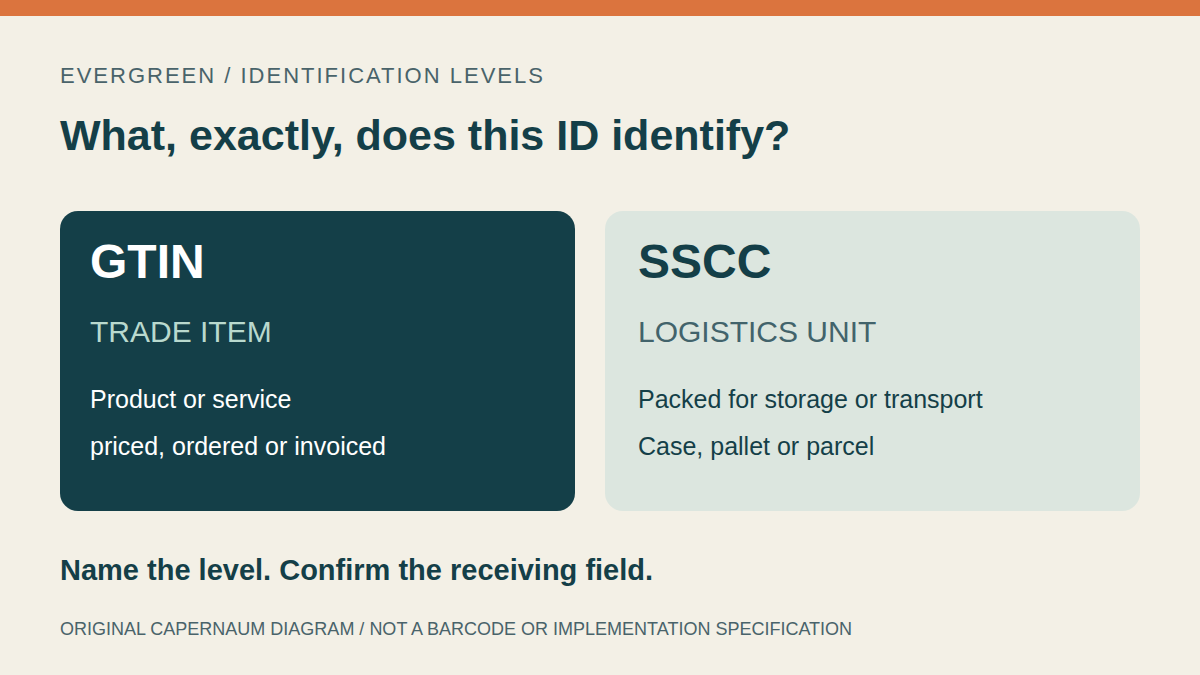
Evergreen logistics explainer. GTIN vs. SSCC is a distinction worth settling before sending product data to a warehouse. One identifies a trade item; the other identifies a logistics unit. Asking for “the barcode” without naming the intended level leaves room for two teams to answer different questions.
This is a terminology and coordination guide, not a barcode implementation specification. It does not announce a new standard, a warehouse integration or a Capernaum scanning service. The practical goal is to help a shipper ask a precise question before preparing labels or exchanging receiving data.
GTIN: identify the trade item
GS1 defines the Global Trade Item Number, or GTIN, as an identifier for trade items. Its definition of a trade item covers products or services that are priced, ordered or invoiced in the supply chain. That is the scope of the sourced definition here.
Our coordination recommendation is to label the product-identity field explicitly when exchanging a receiving brief. Ask whether the receiver wants the GTIN, an internal product code, or another agreed reference. Do not silently rename one field as another simply because both contain numbers or appear near a barcode.
SSCC: identify the logistics unit
GS1 describes the Serial Shipping Container Code, or SSCC, as an identifier for a logistics unit: trade items packaged together for storage or transport, such as a case, pallet or parcel. The word “container” in the name should therefore not lead a planner to assume that the identifier refers only to an ocean container.
The distinction is the object being identified. A request for the identity of a packed pallet is not automatically answered by supplying a trade-item identifier for a product in that pallet. Conversely, a logistics-unit identifier alone does not explain the product description and quantity the receiving team needs. Confirm the intended field and its relationship to the accompanying records.
Use two questions in the receiving brief
Our proposed approach is to separate the conversation into two questions: “Which trade item are we discussing?” and “Which physical logistics unit is being received?” This is an editorial working method, not a mandatory GS1 form.
- Name the identification level: Say whether a field describes the trade item or the logistics unit. Preserve the actual identifier type supplied by the responsible team.
- Confirm the receiver’s expectation: Ask which identifier belongs in each receiving field and which labeling specification applies to this shipment. A general definition does not establish one facility’s acceptance rules.
- Agree the link: Ask how the receiving record associates a logistics unit with its contents. Keep the product references and quantities available without treating them as substitutes for unit identity.
- Check a sample before rollout: Where a data or label exchange is planned, ask the responsible teams to validate a sample through their agreed process. Record what was actually tested rather than assuming that a readable number means a working system connection.
A fictional mixed-pallet example
Imagine a shipper preparing a pallet containing two different products. The warehouse asks for a logistics-unit identifier, while the shipper sends only the product references. Both teams may have accurate information, but they have not answered the same question. The useful next step is to confirm the identifier type requested and the record that connects that unit to its contents.
This example intentionally supplies no invented GTIN, SSCC or barcode. It is not an instruction for assigning identifiers, creating labels or changing a warehouse system. Use the applicable GS1 specifications and the receiving partner’s confirmed instructions for implementation; this short guide does not replace them.
Our packing-list guide covers the separate task of describing package contents. This explainer focuses on the standard identifier vocabulary used before agreeing a data exchange. For a freight discussion with Capernaum, share the cargo, origin, destination, timing and receiving requirements. Any labeling, data exchange or handling arrangement needs shipment-specific confirmation.
References and scope
Published 2026-11-13. GS1’s GTIN and SSCC reference pages were directly checked November 13, 2026. They are undated standards reference pages, not current news releases. They support only the attributed definitions and examples of identification scope above. The receiving questions, sample-check recommendation and fictional scenario are original editorial guidance. No legal requirement, certification, barcode specification, software compatibility, client outcome, rate or capacity claim is made. Source text, logos and illustrations are not reproduced.