
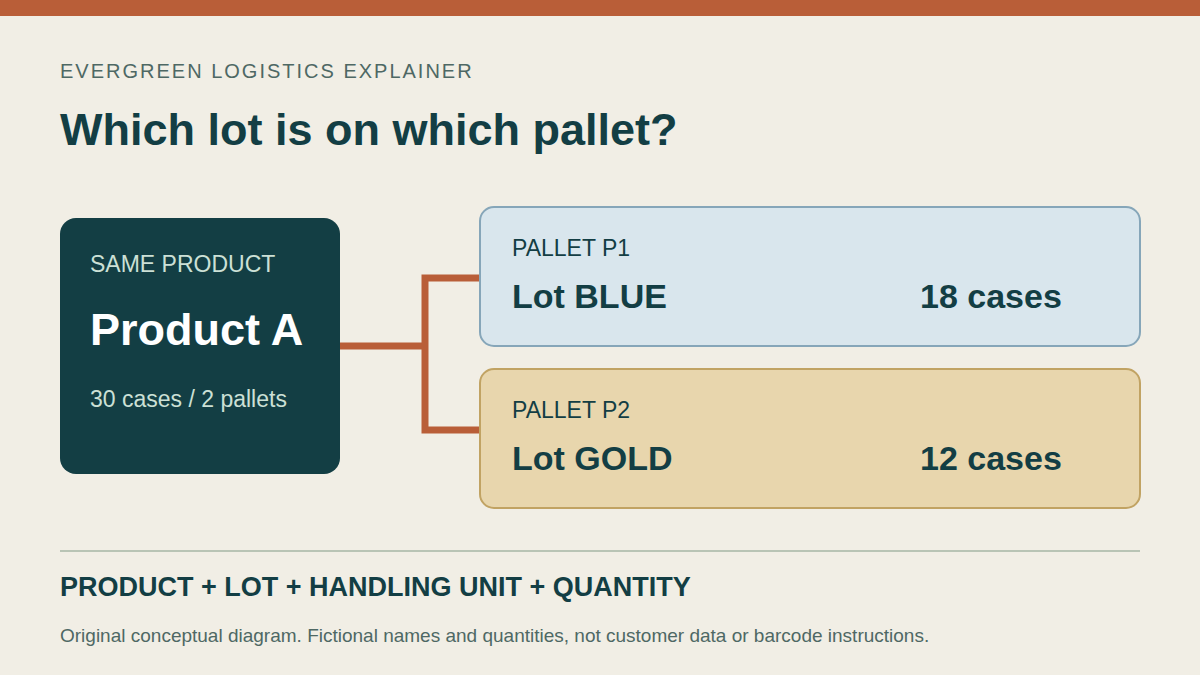
Evergreen logistics explainer. A batch or lot number answers a different question from a product code or a pallet count: which identified group of this product is involved? When one shipment contains several lots, an aggregate quantity can balance while leaving the receiving team unable to tell which lot is on which handling unit. Keep the lot-to-unit relationship visible before the next freight handoff.
Keep the product and its lot together
The GS1 Application Identifier reference describes AI (10) as the batch or lot number. It lists production date and expiration date under separate identifiers. For this coordination guide, the important distinction is simple: do not silently treat a lot value as a date, a product identifier or an instruction to release goods.
Microsoft's item-tracing documentation provides a concrete software example. Tracing uses an item number and a tracking dimension such as a batch, serial or vendor batch number. Its results depend on recorded inventory transactions and have documented limits. That supports retaining both the product reference and the tracking value, not assuming that one free-standing number tells the entire shipment story.
Map quantities by lot and handling unit
Our operational recommendation is a lot-level handoff map. Keep the exact product reference, lot value as supplied, handling-unit reference, quantity and counting unit on each line. Ask the product-data owner to confirm ambiguous characters and preserve leading zeros. Identify who supplied the information and whether it describes planned contents or physically checked contents.
Fictional example: a shipment contains 30 cases of product A. Pallet P1 carries 18 cases from lot BLUE; pallet P2 carries 12 cases from lot GOLD. Recording only “product A, 30 cases, 2 pallets” preserves the total but loses the lot allocation. The names and quantities here are teaching examples, not customer records, barcode values or industry pack standards.
If one pallet contains both lots, use separate content lines under that pallet reference. Do not invent a combined lot value to make the record shorter. A logistics-unit identifier and a lot attribute describe different aspects of the load. Our GTIN and SSCC guide covers product versus logistics-unit identity; this explainer adds the lot-level content relationship inside that structure.
Preserve the relationship when freight is split
If the example load is divided for onward distribution, record how much of each lot goes to each outbound unit and what remains. Suppose six cases of BLUE move from P1 to a new outbound unit. The original map should not continue to imply that all 18 BLUE cases remain on P1. Record the change and confirm the resulting quantities with the team responsible for the physical handling.
This is an original coordination recommendation, not a claim that every carrier or warehouse performs lot-level counting. Agree who maintains the record, who checks the physical contents and what evidence will accompany the handoff. Do not assume that booking transportation includes inventory-system configuration, label generation or product traceability services.
Treat missing lot detail as an unresolved question
When the packing record names one lot but the receiving record names another, preserve both observations and ask the responsible shipper and receiver to reconcile them. Do not overwrite a physical observation solely to match a planned document, and do not infer a shortage from a vocabulary mismatch alone. If a lot field is blank, mark it unconfirmed rather than filling it from a previous shipment.
Keep movement decisions separate from data cleanup. A lot number does not by itself establish product condition, quality approval, expiration status or permission to substitute one lot for another. Obtain any required product-specific direction from the responsible owner. This article does not provide recall, regulatory, food-safety or treatment advice.
Agree the handoff boundary before booking
For a drayage, cross-dock or regional distribution discussion, distinguish the physical movement brief from any inventory task. Share the handling-unit count, packed dimensions and weights, origin, destination and timing. Then separately confirm whether a lot map is required, who will supply it, who will verify it and how exceptions will be reported. Discuss the actual movement requirements with Capernaum Transport rather than assuming an unquoted inventory service is included.
The useful outcome is not a longer document. It is a clear answer to three questions: which product and lot, on which unit, in what quantity? Keeping those answers connected gives the next team a usable record without claiming that paperwork alone proves the goods were checked.
References and scope
References checked November 18, 2026 (2026-11-18): GS1 Application Identifiers, current undated reference, supports the batch/lot terminology and separation from date fields; Microsoft Learn, Item and raw material tracing in inventory, production, and sales, documentation dated May 22, 2026, supports item-plus-tracking-dimension tracing and its software-specific limits. The mapping method, fictional quantities, split-load example and exception questions are original operational analysis. This evergreen explainer reports no new event, market reading, transport regulation or guaranteed service outcome.