
Evergreen logistics explainer
A cross-docking plan connects specific inbound freight to a specific outbound movement. An arrival time alone does not describe which goods should leave, where they should go or what happens to the rest. For a shipper arranging a warehouse transfer, the useful starting point is a quantity-and-destination map, not just two truck appointments.
What cross-docking means in the reference
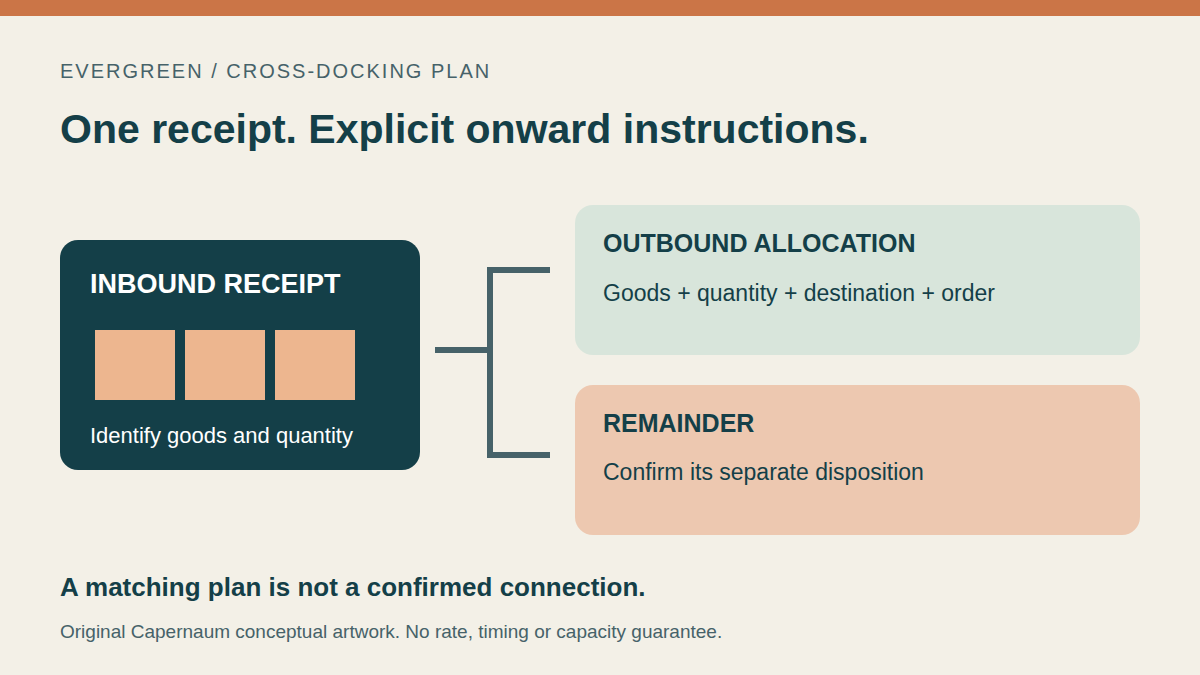
Microsoft Learn’s planned cross-docking documentation describes directing the inventory needed for an outbound order from receipt to an outbound dock or staging area, while directing the remaining inbound inventory through normal put-away. Its example separates one inbound receipt into a portion assigned to an outbound order and a remainder destined for storage.
That is documentation for Dynamics 365, not a universal warehouse rule and not a description of software used by Capernaum. It provides a concrete illustration of the planning distinction: the inbound load and the outbound allocation need not be the same quantity. We do not apply its configuration settings or example time windows to other facilities.
Build the match before discussing the connection
Our recommendation is to prepare a short allocation brief for the warehouse and transportation contacts. The purpose is to make the requested transfer explicit so those parties can confirm what they can accept.
- Identify the inbound source. Name the shipment reference, origin, expected arrival and the handling units the warehouse should expect. Distinguish an estimate from an accepted receiving appointment.
- Identify each outbound destination. Connect the relevant goods and quantity to a named order or movement reference and receiving location. Use a consistent unit of measure so “cases” and “pallets” are not treated as interchangeable.
- State the handling scope. Ask whether the request is a transfer of intact units or includes sorting, breaking down, relabeling or rebuilding units. Request confirmation of the actual work rather than assuming the term cross-docking includes it.
- Give the remainder a destination. If only part of the receipt is allocated onward, request instructions for the balance. Storage, another outbound move and an unresolved hold are different plans.
- Name the decision owner. Identify who can approve a revised allocation if the receipt differs from the plan or an outbound movement changes.
Timing is a separate confirmation
Microsoft’s documented workflow includes configurable checks for the interval between supply arrival and demand departure. That establishes a feature of the described system, not a standard connection time for freight. No fixed dwell time, same-day transfer or reduction in charges is promised here.
For an actual move, ask the facility and transport providers to confirm their accepted timing, required handling work and communication process. An inbound estimated arrival and an outbound requested pickup can be written on the same brief without either being confirmed. Keep those status labels visible.
If timing changes, our recommendation is to ask the responsible parties whether the original allocation still works, what happens to the freight while a decision is pending, and who will issue the updated instructions. Do not treat an earlier plan as a fresh confirmation after the underlying movement has changed.
A useful hypothetical: one receipt, two dispositions
Imagine an inbound load with some units assigned to a regional delivery and the balance awaiting a later order. This is a planning illustration, not a customer case. A brief that says only “cross-dock the load” leaves the remainder unresolved. A clearer brief names the outbound allocation, the destination and movement reference, and the separately agreed disposition of the balance.
The same principle applies when several outbound destinations share one inbound source: each allocation should remain identifiable. The brief does not replace the warehouse’s own receiving records, accepted work instructions or shipment documents. It makes the shipper’s request easier to reconcile with them.
Keep allocation distinct from receiving verification
An advance shipping notice describes what is expected; a cross-docking allocation describes the intended onward use of identified goods. Neither substitutes for checking what was actually received. Our advance shipping notice explainer covers the expected-versus-observed distinction. This article addresses the next planning question: which received quantity is intended for which outbound movement?
To discuss freight coordination with Capernaum, share the inbound source, cargo, proposed outbound destinations, quantities and requested timing. Any proposed handling, storage or transportation scope requires confirmation. No particular warehouse system, available facility space or guaranteed connection is implied.
Reference and editorial scope
Published 2026-11-16 as an evergreen logistics explainer, not a current news report. Microsoft Learn’s planned cross-docking reference was directly checked November 16, 2026; its document date is 2025-06-17. It supports the described order-linked allocation, remainder-to-storage example and configurable time-window checks in Dynamics 365. The briefing checklist and hypothetical above are original editorial recommendations, not Microsoft requirements or Capernaum operating promises. We make no quantified savings, rate, capacity, regulatory or customer-performance claims. Original artwork illustrates the allocation concept; no publisher prose, charts or photography are reproduced. No interviews or personal field reporting are claimed.