Einride's autonomous freight roadmap separates a future highway target from the operations it already runs. In its November 18, 2026 business update, the company said it is targeting highway autonomy with its next-generation driver technology from the first half of 2028. For U.S. shippers, the practical distinction is between a technology milestone and a service that can accept a specific shipment.
What the update actually says
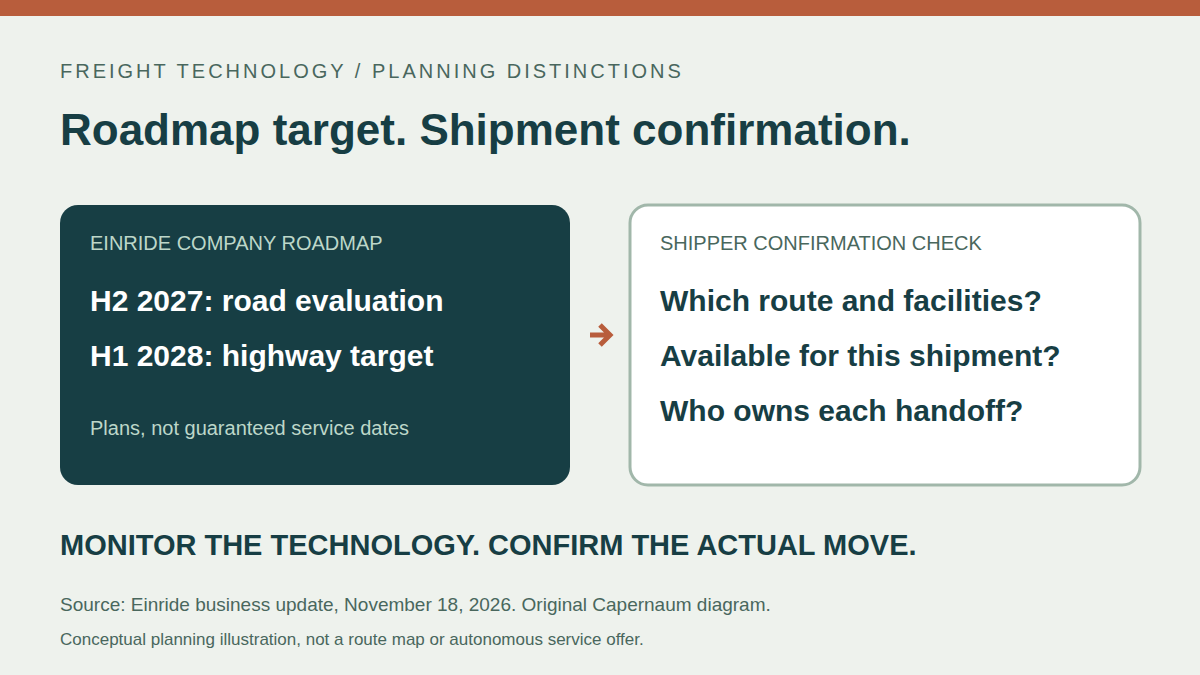
Einride says a live road evaluation involving NVIDIA Alpamayo is planned for the second half of 2027. Its highway autonomy target follows in the first half of 2028. These are company plans, not completed deployments or guaranteed service dates.
The same update describes an existing, narrower operation: two cab-less autonomous electric trucks went into daily freight operations with EASE Logistics in Marysville, Ohio, in September 2026. That operating example should not be read as proof that autonomous highway service is available across the United States.
Trucking Dive's November 19 report independently covers the roadmap and adds an important qualification. An Einride spokesperson told the publication that the company had not disclosed whether the United States or Europe would be the first market for highway-speed operations. The report says that decision depends on safety validation, regulatory approvals and customer demand.
A highway target is not a lane commitment
For a shipper comparing future transportation options, the announcement is worth monitoring. It does not establish an origin-destination pair, a bookable pickup window or a shipment-specific operating arrangement. Those details need a separate answer from the provider.
Our operational recommendation is to keep two lists. One tracks technology developments and future possibilities. The other records services actually confirmed for the freight being tendered. Moving an item from the first list to the second should require a concrete service description, not just a projected launch year.
This is particularly useful when an imported container feeds a regional distribution plan. A future highway option does not itself confirm the port pickup, transload handoff or receiver's unloading arrangement. Each leg still needs its own confirmed scope.
Questions to put in a shipment discussion
- Route and facilities: Which exact pickup and delivery sites are included? Ask whether the proposed movement is a limited facility-to-facility operation or a highway service.
- Availability: Is the service operating and accepting this shipment, or is it a trial, evaluation or future target? Record the provider's answer and date.
- Freight fit: Confirm the commodity, packed dimensions, weight, handling requirements and equipment proposed for the actual move.
- Handoffs: Identify who handles loading, unloading, status updates and exceptions. Do not infer these responsibilities from the vehicle technology.
- Continuity: Ask what happens if the proposed service cannot perform the agreed move. Keep the fallback arrangement separate from any unconfirmed capacity assumption.
These are Capernaum's planning questions, not claims that Einride has adopted a particular booking procedure. They also apply when assessing conventional freight services.
Keep current freight plans grounded in confirmed service
The useful takeaway is not to dismiss autonomous trucking, or to assume it has already solved a lane. Einride has described existing operations alongside a forward-looking highway roadmap. A shipper can recognize both while asking for evidence at the level of its own shipment.
For related handoff planning, see our guide to the difference between a freight quote and a pickup request. If you need to discuss a current U.S. movement, share the shipment details with Capernaum. This article does not announce an Einride partnership, autonomous service offering or capacity commitment by Capernaum.
Sources and timing
Sources checked November 25, 2026: Einride's business update is visibly dated November 18, 2026 (2026-11-18); the page's separate technical publication field shows November 23. Trucking Dive's independent report is dated November 19, 2026. The roadmap is attributed to the company, and the market-selection qualification is attributed to Trucking Dive's reporting. This article reports those dated statements, not a new November 25 launch. No forecasts, financial metrics or performance guarantees have been inferred from them.