
Evergreen logistics explainer. A freight quote helps answer a pricing question. A prepared bill of lading records shipment information. Neither should be used as a shortcut for checking whether a pickup request was actually sent and what response followed. Before telling a warehouse to expect collection, close that request handoff.
This guide focuses on the gap between choosing a quote and asking a provider to collect the freight. It is original operational guidance, not a report of a new carrier tool, a definition of contract acceptance or a promise of same-day capacity.
A connected workflow still has separate actions
The My Estes Shipping Tools reference describes moving between requesting a rate quote, creating a bill of lading and scheduling a pickup without repeatedly entering freight details. That carrier-specific description is useful precisely because it identifies different actions, even when one system carries the shipment information between them.
The Estes digital tools overview also lists Rate Quote, Bill of Lading and Pickup Request as distinct tools. These pages describe Estes, not Capernaum software or a universal carrier workflow. We do not imply a partnership, integration or access to those systems through Capernaum.
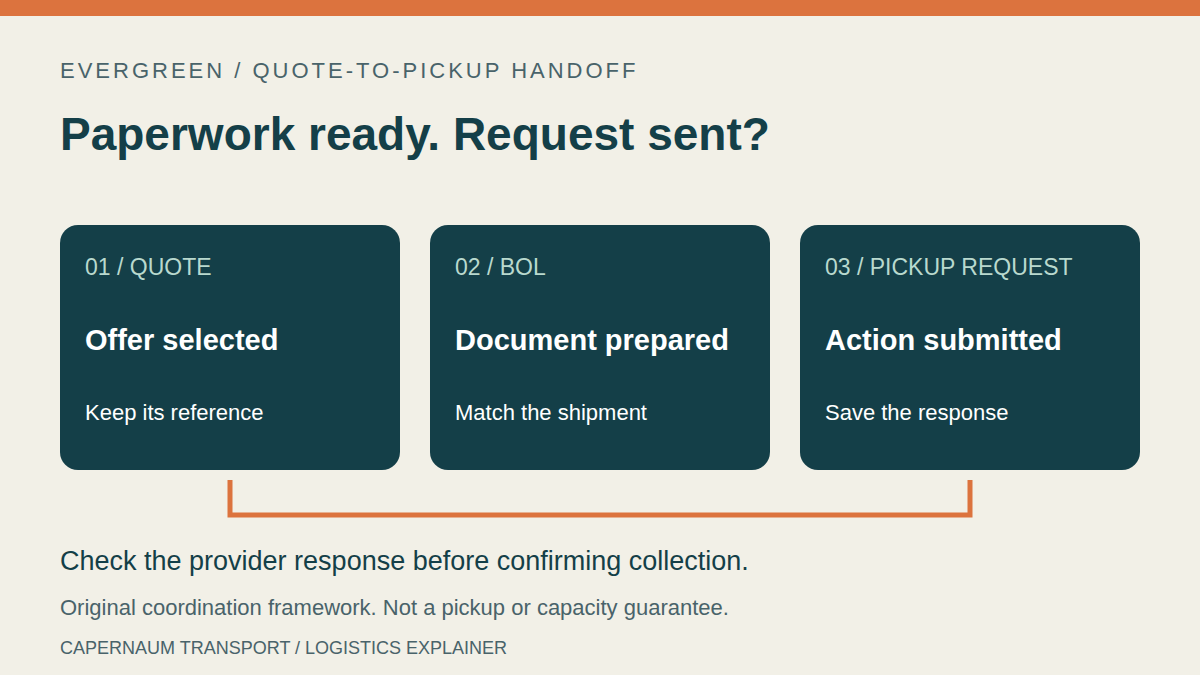
Our recommendation is to track each action explicitly. “Quote chosen” means the team has selected the offer it intends to use. “BOL prepared” means the document is ready. “Pickup requested” means someone has completed the actual request step. Keep a provider response separate again, rather than treating your own request as a guaranteed collection time.
Carry the quote reference into the request
In its freight shipping FAQs, Estes explains that its Rate Quote History lets a user retrieve a quote and use it to request service. Its pickup guidance describes an option to request a pickup from the confirmation screen after submitting a BOL. The same guidance tells customers arranging pickup by telephone to provide their quote number.
Those examples support a narrow practical point: keep the selected quote identifiable when moving to the next action. They do not establish that every saved quote or submitted document automatically creates a pickup. Ask the selected provider how its process works, which reference to supply and what response establishes the request status.
Use a small request-handoff record
The following is our proposed coordination format, not a carrier-mandated form:
- Selected quote: Record the provider, quote reference and the shipment description the offer covers. Retain the actual offer rather than only a price copied into an email.
- Paperwork: Identify the BOL or shipment document being used. Check that it refers to the same move as the selected quote.
- Request action: Record who submitted the pickup request, when and through which agreed channel. If it has not been submitted, say so.
- Provider response: Keep the acknowledgement or other response, any supplied reference and the status as described by the provider. Do not rewrite “received” as “collected.”
- Next owner: Assign the person who will resolve an unanswered request or a mismatch before the warehouse is told the arrangement is confirmed.
Resolve uncertainty without sending duplicate requests
Consider a fictional distributor that downloads a quote, prints a BOL and tells its warehouse that a truck is coming. The coordinator later discovers there is no saved pickup-request response. The useful next question is whether the request was sent, not whether the paperwork looks complete.
As an operational recommendation, check the existing request history or ask the provider through an established contact before creating another request for the same freight. Explain the uncertainty and ask whether an existing request should be updated or a new one submitted. This is a way to keep the coordination record clear, not a statement about any carrier-specific duplicate-handling policy.
If the shipment has changed since quoting, flag the difference and ask the provider what needs updating before reusing the reference. Do not silently apply a saved offer to different freight. For quote-comparison context, see our guide to evaluating an LTL quote. The focus here is the subsequent request action, not price analysis.
To discuss a move with Capernaum, share the cargo, origin, destination, timing and any existing quote or request reference. Ask for shipment-specific confirmation of scope and availability. A quote is not evidence in this article of reserved equipment or a promised pickup.
References and scope
Published 2026-11-09. The three linked Estes reference pages were directly checked November 9, 2026. They are undated reference material, not current news releases. The shipping-tools pages support the attributed distinction between quote, BOL and pickup actions. The FAQ supports the attributed quote-history, post-BOL request option and quote-reference instructions. The handoff record and uncertainty example are original editorial recommendations. No source prose, third-party artwork, customer records, contract interpretation, rates or live capacity figures are reproduced.