
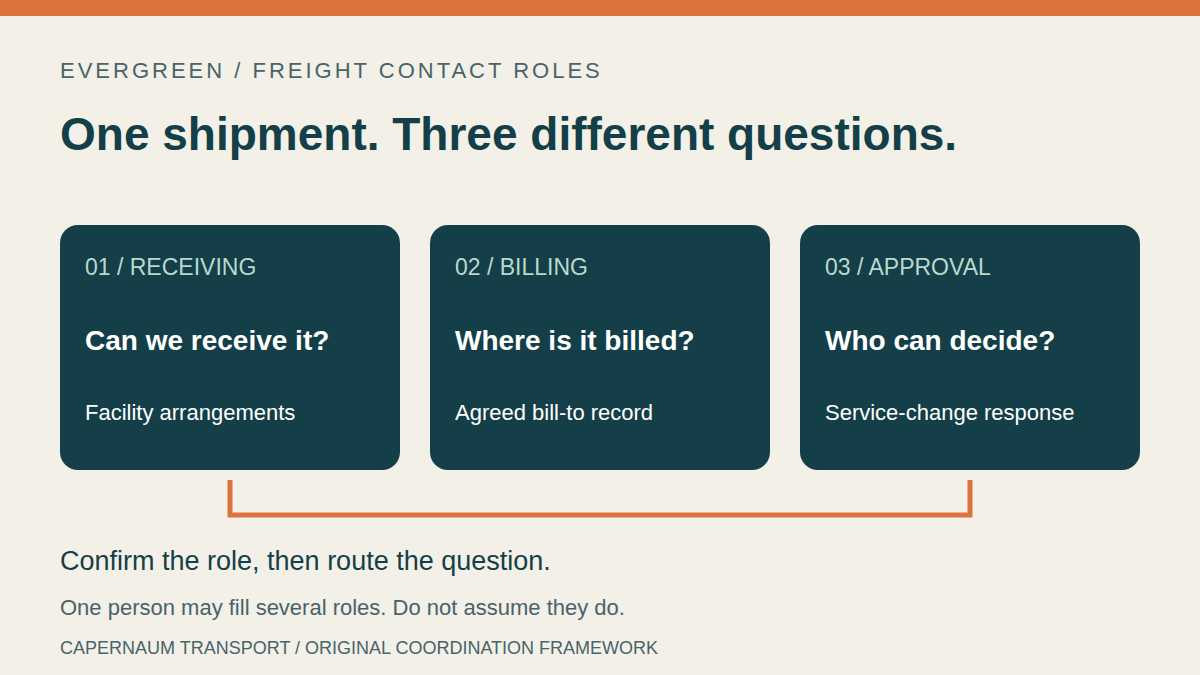
Evergreen logistics explainer. Freight contacts should identify who can answer the particular question, not just provide one name beside a delivery address. The person who can open a receiving dock may not be the person who handles the freight invoice or approves a requested additional service. Map those roles before dispatch instead of expecting the driver or warehouse to find the right decision maker later.
This is an original coordination guide for domestic freight planning. It does not determine legal payment liability, interpret a sales contract or announce a change in carrier rules. One person can fill several roles, but that should be confirmed rather than assumed.
Receiving and freight billing are different fields
The Estes transportation glossary defines consignee as the designated recipient of a shipment shown on the bill of lading. The same glossary describes a third party, in its payment terminology, as a paying party other than the shipper or consignee. These definitions support a useful distinction: the physical recipient and the intended freight payer need not be the same party.
Estes also defines prepaid freight charges as charges that have been or will be paid by the shipper and/or a third party. Its collect definition refers to payment by the consignee upon delivery or through an established account. These are attributed reference definitions, not instructions to select a payment term for a particular shipment. In particular, do not read the word prepaid alone as proof that an invoice has already been settled.
Our recommendation is to retain the payment instructions actually agreed for the move and identify the billing contact separately from the receiving contact. If the documents conflict, ask the responsible commercial parties and selected provider to resolve the difference. A coordinator should not decide who owes a disputed charge by choosing whichever contact answers first.
Give service-approval questions their own route
The Estes FAQ on accessorial preauthorization asks shippers using that process to identify the person authorized to approve the service or payment on the bill of lading, with contact details. That is a carrier-specific instruction, not a universal rule or a statement about Capernaum procedures. Check the applicable instructions with the selected provider for the actual move.
The operational lesson is narrower: receiving freight and authorizing an additional service are not interchangeable responsibilities. Ask who can make the relevant decision, how that person can be reached during the planned move, and what the team should do if no response arrives. Do not describe silence as approval.
Build a three-role contact map
The following is our proposed planning format, not a carrier form or a replacement for shipment documents:
- Receiving contact: Identify the facility and the person or team that confirms the receiving arrangements. Record an agreed way to reach them and the hours relevant to the move.
- Freight billing contact: Identify the intended bill-to party, the agreed billing reference and the person who can clarify invoice routing. Keep account details in the appropriate private shipment record, not on a public handoff board.
- Service-approval contact: Identify who can respond to a proposed change or additional service, what question they are authorized to decide, and the agreed escalation route.
Where the same person covers two roles, say so explicitly. Where the role is unconfirmed, mark it unconfirmed and assign a coordinator to close the gap. Avoid circulating private contact information beyond the people who need it for the shipment.
Test the map with a realistic question
Consider a fictional distributor whose warehouse can confirm a delivery window, while its central office handles freight invoices. A request for an additional delivery service arrives. Calling the dock may resolve access but not the service decision. Forwarding the question to accounts payable may resolve invoice routing but still not establish who can approve the change.
Under our proposed approach, the coordinator routes the specific question to the recorded approval contact, preserves the response and shares the resulting operating instruction with the affected team. The example illustrates role clarity, not an actual customer event, fee entitlement or permission to perform an unapproved service.
This role map complements our inland booking-brief guide: that article separates commercial terms from dispatch information; this one identifies who answers receiving, billing and approval questions. To discuss a move with Capernaum, provide the cargo, origin, destination, timing and relevant role contacts through the agreed private channel. Scope and availability need shipment-specific confirmation.
References and scope
Published 2026-11-11. The Estes transportation glossary and freight shipping FAQ were directly checked November 11, 2026. They are undated reference pages, not news releases. The glossary supports the attributed consignee, third-party, prepaid and collect definitions. The FAQ supports only the attributed carrier-specific approval-contact example. The contact map and fictional scenario are original editorial recommendations. No tariff consequences, legal liability, new regulation, rates, capacity, partnership, customer information or third-party artwork is asserted or reproduced.