
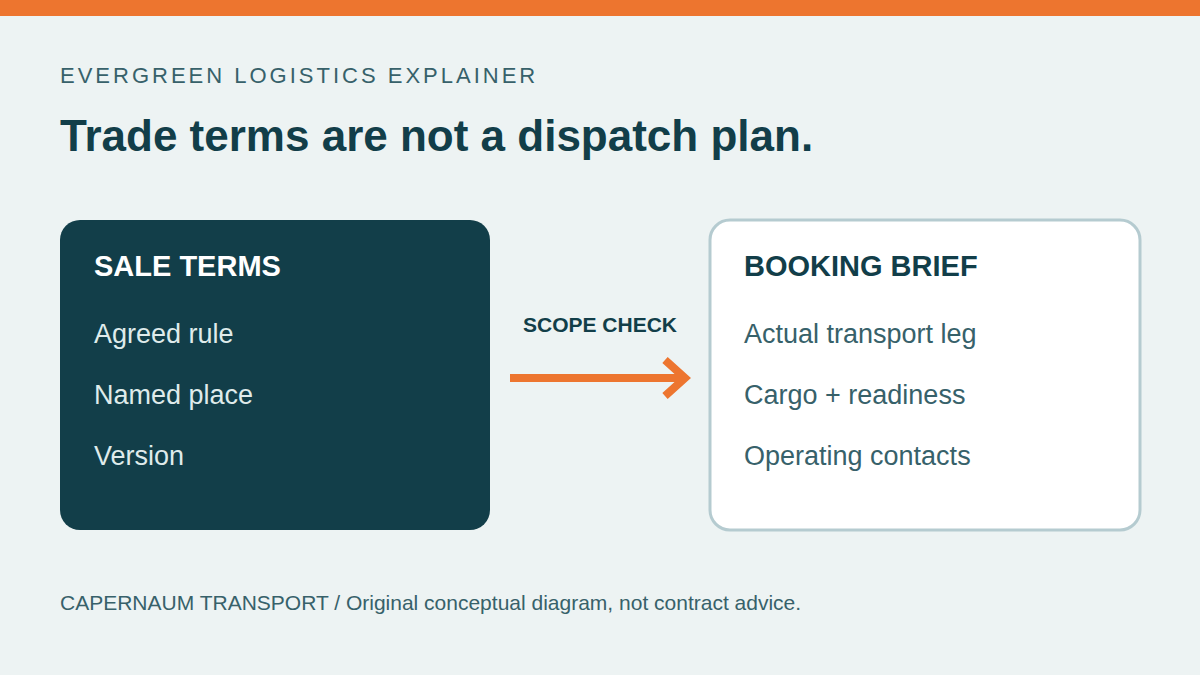
Evergreen logistics explainer. Incoterms can help a buyer and seller describe their responsibilities, but an inland freight booking still needs a usable operating brief. A three-letter term on a purchase order does not tell a dispatcher which gate to use, which shipment reference to quote or whether a receiving appointment has been confirmed.
The International Chamber of Commerce overview describes its Incoterms® rules as trade terms that clarify tasks, costs and risks in delivering goods between sellers and buyers. The International Trade Administration reference explains their role in assigning responsibilities for transport and related activities. Those references support the general distinction here. This article does not select a rule or interpret a sales contract.
Start with the agreed term, place and version
As an operational practice, ask the responsible commercial contact to provide the complete agreed reference, including the named place or port and the version used. Do not shorten it to three letters in a booking request. ITA lists named locations with the rules and explains that parties should clearly identify the version they agree to use.
Then ask that contact to confirm the transport scope being requested. Is this booking for the inland pickup only, an onward domestic leg or another specifically described movement? Record the actual origin and destination separately. A commercial place name and a dispatch address should not be treated as interchangeable without confirmation.
If the sales documents and the requested move conflict, return the question to the parties responsible for the agreement. The dispatcher should not resolve a contractual disagreement by guessing which location or payer was intended.
Build a separate booking brief
Our recommendation is to keep two linked records: the agreed commercial reference and the operating instructions for this particular movement. The second record should answer practical questions without rewriting the first.
- Move: state the pickup and delivery addresses, facility names and the leg being booked.
- Freight: provide the cargo description, handling-unit count, weight, dimensions and any handling needs that must be evaluated.
- Readiness: identify who can confirm that the cargo is available and provide the shipment references needed for pickup.
- Receiving: identify who confirms the delivery window and any facility-specific access or unloading arrangements.
- Commercial contact: identify who is authorized to confirm the requested service and its charges under the actual booking agreement.
This checklist is original operational guidance, not a list of obligations assigned by any particular Incoterms rule. For a container move, use the drayage guide to discuss the physical leg. Keep the cargo contents record distinct too: our packing-list explainer focuses on what is in each package, not who contracts for transport.
Do not turn one responsibility into every responsibility
ITA explains that Incoterms do not settle all terms of a sale, including payment timing or when ownership passes. Avoid using the trade term as a shortcut for those separate questions. Nor should an operating team infer a confirmed appointment, cargo-release status or a carrier booking from a term appearing on a commercial document.
Consider an illustrative request reading only “collect under the agreed Incoterms.” Before arranging the truck, the useful follow-up is not to choose a different rule. It is to obtain the exact collection address, cargo information, readiness confirmation, receiving plan and authorized booking contact. Questions about the contractual allocation of risk, insurance or clearance belong with the responsible parties and qualified advisers.
Use a scope check before release
Ask the commercial contact and transport coordinator to compare the proposed move with the agreed scope. If the request changes, preserve the updated instructions and confirm who authorized them before proceeding. A simple written scope check is more useful than forwarding a document containing a trade term and assuming the next team can fill in the gaps.
For an inland freight discussion, contact Capernaum with the cargo, actual origin and destination, timing and requested transport leg. Availability, coverage, handling arrangements and price need shipment-specific confirmation. This explainer does not announce customs brokerage, legal advice, insurance coverage or guaranteed capacity.
References and scope
Published 2026-11-02. ICC Incoterms rules and ITA Know Your Incoterms reference pages were directly checked November 2, 2026. Both are reference material, not current news releases; no new rule or market event is reported. ICC supports the general tasks, costs and risks definition. ITA supports the named-location/version and limits-of-scope discussion. The two-record booking brief and scope check are original editorial recommendations. No rule text, publisher artwork, customer records or contractual interpretation is reproduced.