
Evergreen logistics explainer
A freight delivery address identifies a destination. It does not, by itself, tell a driver which entrance the receiver authorizes for a truck. Keep the destination address, building or unit, and confirmed receiving entrance together, but in separate fields. A map pin can supplement that record; it should not silently replace it.
This is an evergreen planning guide, not a report of a new address rule, a holiday closure or a specific shipment. The workflow below is original operational commentary for ordinary freight coordination, not truck-routing or site-safety advice.
What a standardized address actually establishes
The USPS Publication 28 definition of a complete address concerns the elements needed to match Postal Service address files. A standardized address uses the required elements and postal abbreviations. That is a postal addressing standard, not a certification of a warehouse entrance, truck access or unloading arrangements.
Section 213 on secondary unit designators distinguishes details such as building, suite and unit. Preserve the receiver's correct building or unit information rather than assuming the street number identifies the whole receiving operation. Do not invent a suite number from a dock number: those labels can serve different purposes.
Separate destination identity from the arrival point
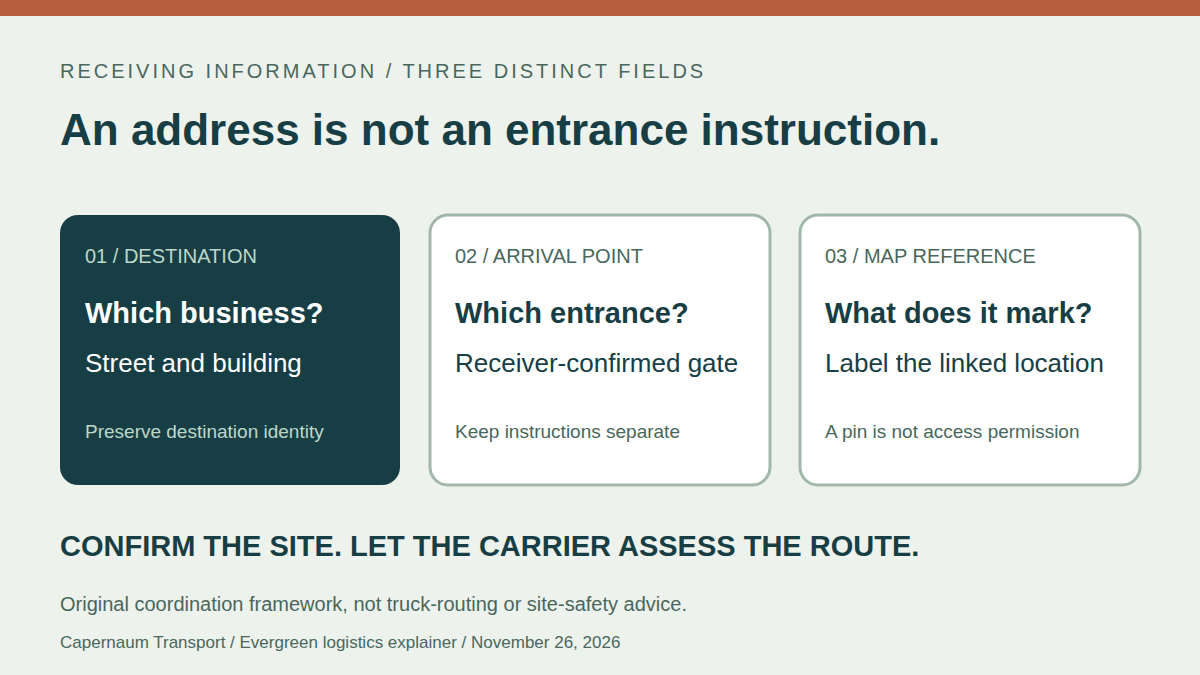
Our recommended receiving record has three layers:
- Destination identity: receiving business name, street address, building or unit, city, state and ZIP Code as confirmed by the receiver.
- Authorized arrival point: the receiver's stated truck entrance, gate or check-in location, described separately from the destination's postal address.
- Supporting location reference: a receiver-confirmed map link or coordinate, labeled with what it represents and when it was checked.
A gate reference should say whether it marks the entrance, a check-in point or the building itself. A precise pin with an unclear meaning is still an unclear instruction. If a receiving entrance uses another street, record that distinction without overwriting the shipment's destination address or assuming a different consignee.
A map coordinate is a location reference, not permission
Google Maps documents how to search using coordinates and specifies latitude before longitude. That supports sharing a location in a consistent format. It does not establish that the location is an authorized commercial vehicle entrance or that a route is suitable for the assigned equipment.
Our operational recommendation is to have the receiver identify the intended arrival point and have the carrier assess routing and access for the actual vehicle. Do not turn a general map's shortest route, a satellite image or an unlabeled pin into a truck-access instruction. If information conflicts, resolve it with the receiver and carrier before treating it as an executable arrival plan.
A fictional multi-building example
Imagine a receiver whose paperwork identifies Building B at a business park. A map search opens a visitor entrance, while the receiver's instructions identify a separate freight gate. These are fictional details, not a description of a customer or an actual site.
The useful handoff preserves Building B as destination identity, labels the receiver-confirmed freight gate as the arrival point, and attaches any map reference to that gate. It also states who confirmed the information. It does not erase the original destination, rename the visitor entrance or promise that every vehicle can use the gate.
Resolve conflicting addresses before dispatch
When a purchase order, booking request and receiving instruction disagree, send the conflicting fields back for clarification rather than choosing whichever address looks most familiar. Ask: Is this the shipment destination, a billing address, or an arrival instruction for the same facility? Record the answer and pass the same clarified record to the parties coordinating the move.
Keep this check distinct from confirming a receiving appointment. Knowing where to arrive does not confirm when the facility will accept freight. Likewise, a complete address does not establish unloading equipment, service scope or a delivery guarantee.
For a Capernaum freight inquiry, share the origin, destination and known receiving requirements. Clearly flag any entrance or building detail still awaiting confirmation so the move can be discussed on the same factual basis.
Reference and scope note
References checked 2026-11-26: USPS Publication 28, October 2024 edition, sections 211 and 213; Google Maps coordinate help, which displays no publication date. These support the postal-address and coordinate definitions above. The three-layer receiving record and conflict-resolution steps are original operational recommendations, not USPS or Google freight requirements. No current market conditions, carrier availability, customer results or new regulations are asserted.