
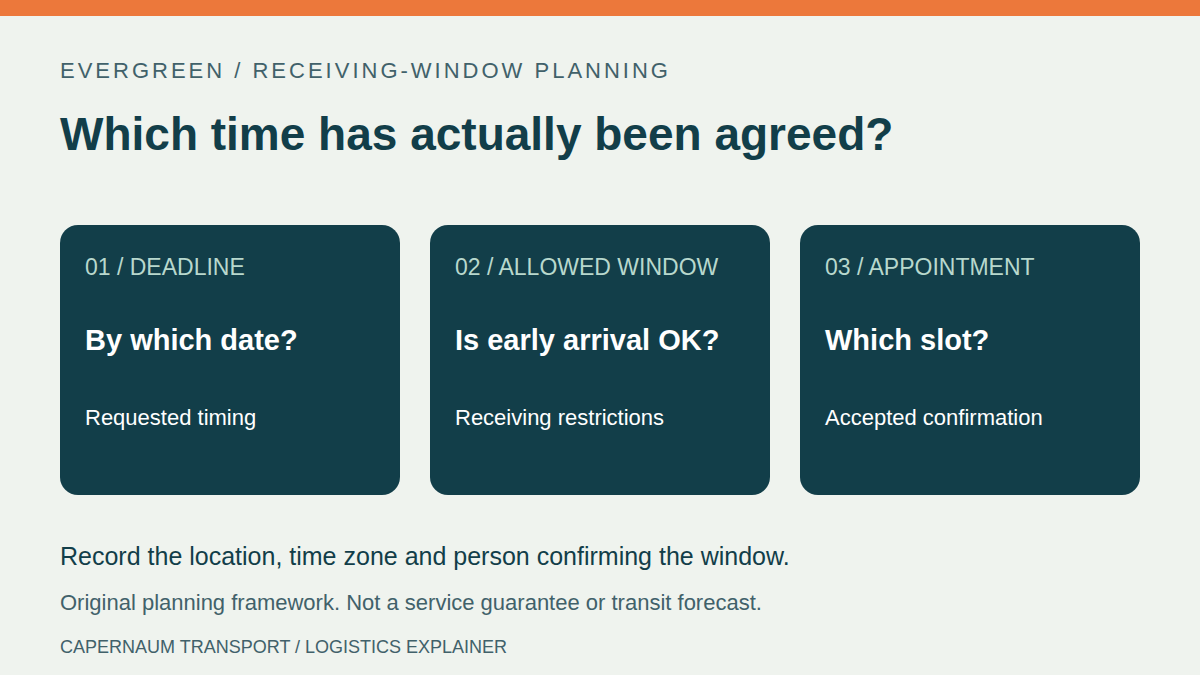
Evergreen logistics explainer. A freight delivery date is not a complete receiving instruction. Before dispatch, separate the requested deadline, any restriction on arriving early, and the appointment actually accepted by the receiving location. Writing those fields separately helps a coordinator see what is agreed and what remains unresolved.
This is original shipment-planning guidance, not a current market report or a new carrier rule. It is especially useful when arranging LTL or regional freight for a warehouse that controls when it will receive a shipment. The examples below explain information to confirm, not a promise that a particular service is available.
A deadline is different from an allowed delivery window
A useful carrier-specific example appears on the Estes Time Critical Guaranteed page. Estes distinguishes Must Arrive By Date, which it describes as arrival by a specified date, from No Sooner, No Later, which it describes as delivery neither before nor after an agreed date. It also describes Required Delivery Date as arrival on a specific date.
Those are Estes service descriptions, not universal definitions or an account of Capernaum service terms. Their practical lesson is narrower: “by this date” and “on this date” can express different requirements. Do not assume a provider uses the same labels or that a date-specific requirement has been accepted simply because it appears in your request.
For example, a requested Friday deadline does not tell a coordinator whether Thursday receiving is allowed. Likewise, Friday business hours do not identify a reserved slot within those hours. Our recommendation is to ask the receiver about both early-arrival restrictions and the process for reserving time, then ask the provider to confirm whether it can meet the resulting scope.
Record requested, scheduled and completed separately
The Estes Appointment Research Tool description distinguishes when appointments were made, scheduled and completed alongside transit events. That is another carrier-specific example of keeping milestones separate. We are not announcing that tool as new, endorsing its performance claims or implying access to it through Capernaum.
In your own coordination note, distinguish a request sent to a warehouse from a slot the warehouse has confirmed. Also separate a later arrival report from the original booking. This article does not establish what any timestamp means under a carrier contract or whether it resolves a chargeback.
Build a receiving-window note before dispatch
The following format is our editorial recommendation, not a carrier-mandated document:
- Receiving location: Record the correct facility and receiving entrance, not only the corporate address.
- Required date and early-arrival rule: State whether delivery is wanted by a date, on a date or within a range. Mark unanswered restrictions as unconfirmed.
- Appointment window: Record the accepted start and end times, time zone and confirmation reference if one is supplied. Do not invent a reference to fill a blank.
- Confirmation owner: Identify who requests the slot, who confirms it and who passes the accepted instructions to the transport provider.
- Mismatch response: Agree who should be contacted if the proposed service cannot meet the window or the receiver changes it.
Resolve a mismatch instead of silently editing the date
If a transport offer gives an estimated delivery day but the receiver requires a particular slot, keep the difference visible. Ask for a shipment-specific confirmation before treating the plan as agreed. A receiving appointment is not, by itself, evidence that a separate transportation guarantee was purchased or accepted.
When a slot changes, preserve the earlier confirmation and record the new instruction, who issued it and whether the relevant parties acknowledged it. Our freight document revision guide covers that change-control task. This article focuses instead on the date and window that need confirming in the first place.
To discuss a move with Capernaum, share the cargo, origin, destination, timing and receiving constraints. Ask for confirmation of scope and availability. No affiliation with Estes, guaranteed appointment product or particular carrier capacity is implied.
References and scope
Published 2026-11-08. The two linked Estes reference pages were directly checked November 8, 2026; neither displayed a publication date in the checked text. They support only the attributed service descriptions and appointment-milestone distinctions. They are not evidence of a new event or universal industry terms. The receiving-window note and mismatch workflow are original editorial recommendations. No source prose or imagery is reproduced, and no legal, tariff, claims or chargeback advice is offered.