
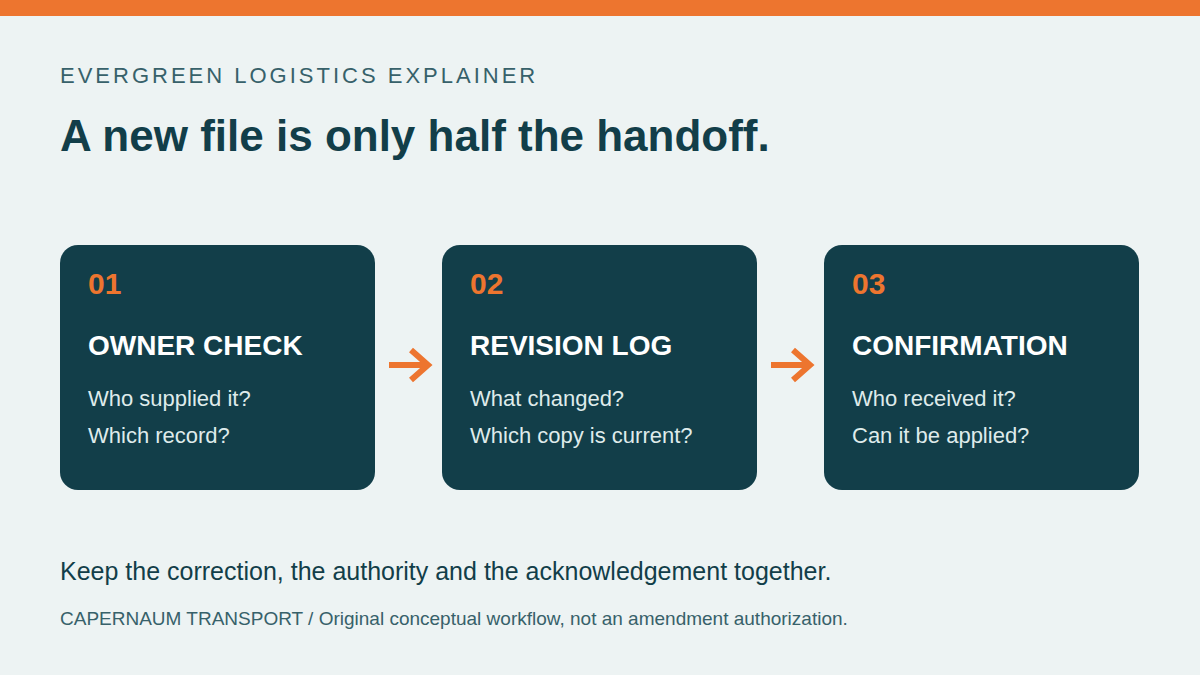
Evergreen logistics explainer. Freight document revision control is a practical handoff problem: one person has the corrected information while another is still working from an earlier file. A revised attachment does not, by itself, establish that the warehouse, transport coordinator and receiving contact are all using the same instructions.
This article offers an original change-control routine for shipment coordination. It is not a rule for amending transport contracts, customs filings or documents of title. Those changes must follow the responsible issuer’s process. No new regulation, current market condition or customer shipment is reported here.
Identify the record before changing the file
The International Trade Administration’s Common Export Documents reference distinguishes documents by purpose. A commercial invoice records the sale of goods; an export packing list describes packages and cargo details; a bill of lading is a contract between the owner of the goods and the carrier. Those are different records, not interchangeable versions of one form.
For coordination, our recommendation is to begin with a small document register: document type, shipment reference, issuer or owner, current revision identifier and the date it was received. Keep the original document number separate from an internal revision label. A team-created label is a filing aid, not an issuer-assigned identifier or proof that an amendment is valid.
If a document appears inconsistent, ask its responsible owner to check it. Do not silently edit a carrier-issued or third-party record to match an internal spreadsheet. A mismatch is a question to resolve, not permission to overwrite someone else’s document.
Make freight document revisions explicit
Send a concise change note with the replacement file rather than relying on a filename such as “final-new.” We suggest five fields:
- Record: identify the shipment and the specific document being replaced.
- Version: state the new revision label and which earlier copy it supersedes for the stated purpose.
- Change: describe the affected field, without exposing unnecessary commercial or personal information.
- Owner: identify the responsible person who confirmed the correction or supplied the revised record.
- Effect: say which operating instructions need review, and which confirmations remain outstanding.
For example, a shipper may advise that a pickup contact has changed. The useful update names the shipment, identifies the replacement operating note and asks the team arranging collection to acknowledge the new contact. It should not claim that a carrier document, appointment or commercial agreement has been amended merely because that note was sent.
Check related records without treating them as substitutes
ITA says a packing list is not a substitute for a commercial invoice and that the invoice should reflect the information shown on the packing list. That supports checking related cargo details for consistency, not combining the records into one document or assuming every correction belongs on every form.
As an operational practice, route a changed count, weight or destination to the people responsible for assessing its effect on the booking and the affected records. Ask them what needs to be corrected through their actual process. Do not infer that an unchanged price, a new cargo count or a revised address automatically leaves every other instruction valid.
The packing-list guide explains the package-to-contents record. This revision routine addresses a different problem: distributing and acknowledging a correction after information has already been shared.
Close the loop with the people doing the work
Keep a recipient list based on the change’s actual effect. Ask the relevant coordinator to confirm receipt and whether the update can be applied before the next handoff. “Email delivered” and “instructions accepted for this move” should be separate entries in the change log.
If a truck is already dispatched or cargo is already at a facility, state that timing in the update and obtain a specific response. Do not assume that a new attachment can reverse work already performed. Preserve earlier versions in a clearly superseded archive so the team can reconstruct what was issued and when, while keeping the current working copy easy to identify.
For a freight discussion, contact Capernaum with the current shipment details and clearly identified outstanding changes. Service scope, timing, availability and charges require shipment-specific confirmation. This workflow does not promise legal advice, customs brokerage, guaranteed capacity or automatic amendment of any transport document.
Reference and scope
Published 2026-11-03. The ITA Common Export Documents reference was directly checked November 3, 2026. It is an undated reference page, not a current news release. It supports the document-purpose distinctions and the invoice/packing-list consistency point. The register, five-field change note, recipient acknowledgement and superseded-copy archive are original editorial recommendations, not legal requirements or an issuer’s amendment procedure. No source prose, publisher images, customer records or live shipment identifiers are reproduced.