
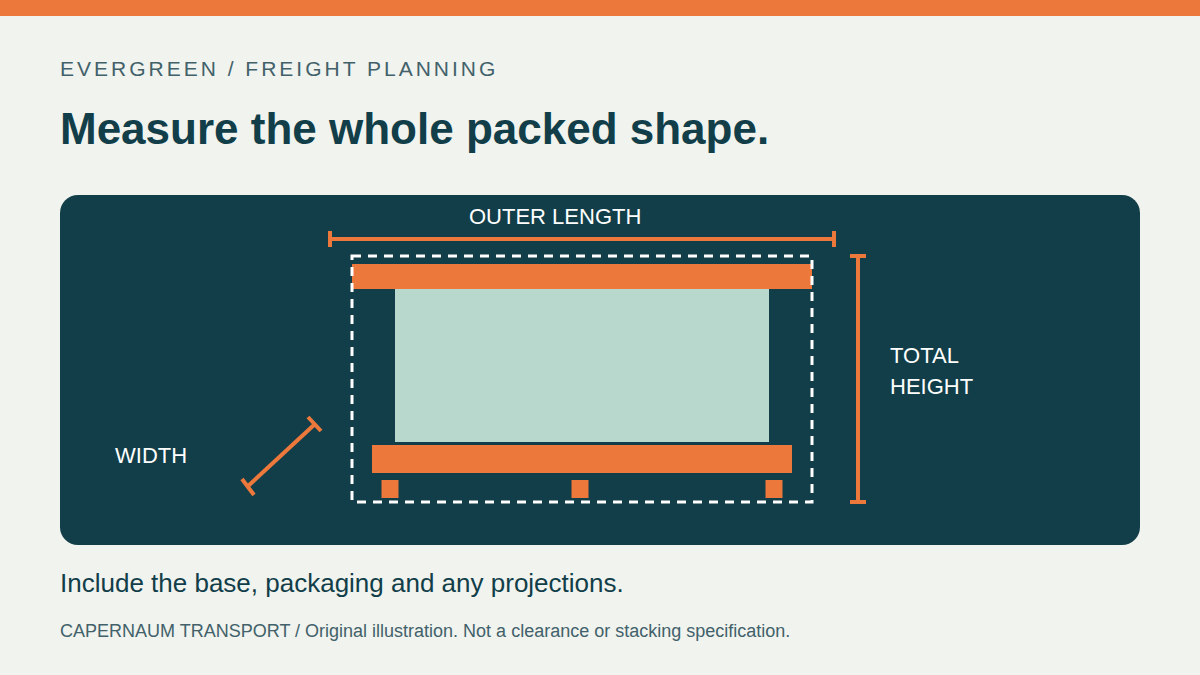
Evergreen logistics explainer. Freight dimensions should describe what will actually be collected. The size printed on a pallet specification is not necessarily the size of the complete packed unit. A crate, protective cap or item extending beyond the base can make the shipping shape different from the pallet underneath it.
Before requesting an inland move, our recommendation is to describe the outer packed envelope: the overall length, width and height of each ready-to-ship handling unit. This is a planning handoff, not an equipment-clearance calculation, packaging design or promise of a particular freight charge.
A pallet footprint is only two dimensions
The base describes a footprint. The complete unit also has height, and the cargo or packaging may extend beyond that footprint. Do not turn a familiar pallet size into a complete shipment description without checking the finished load.
Estes’ freight density reference illustrates this distinction by adding pallet height to shipment height and using the pallet’s length and width in its palletized example. Its separate guidance for irregular objects uses the greatest dimension on the cylindrical plane. Those examples support checking the occupied envelope rather than using product dimensions alone. They are Estes reference examples, not a universal pricing formula or instructions for every cargo shape.
The International Trade Administration’s export-document reference also identifies package types, package counts and dimensions where appropriate as packing-list information. The limited point here is that dimensions belong with an identified package. That reference does not establish an inland carrier’s measurement or billing rules.
Describe the finished shape, not the catalog item
Our suggested workflow is to check the unit after its final packaging is in place. Record overall length, width and total height, with units written beside the figures. Explain what was measured, including the pallet or skid, crate, cap and any projection. Ask the provider how it wants irregular or unusually shaped freight documented.
A photograph or simple sketch can clarify where an item projects beyond its base. Use it to supplement the measurements, not to claim a measured result from an image. Keep private labels and customer information out of any material shared beyond the authorized shipment team.
Do not shorten a dimension to make a booking field accept it. If the form does not capture the shape, give the provider the actual details and obtain its instructions before confirming the request. Identify estimates openly when the unit is not yet packed.
One fictional load, two different descriptions
Imagine a pallet base measuring 48 by 40 inches. After packing, a protective cap extends the overall length to 52 inches, the packed width remains 40 inches and the total height from the bottom of the pallet to the top of the cap is 60 inches.
In this fictional example, “one 48-by-40 pallet” leaves out the projection and height. A clearer planning description is “one packed unit, overall 52 inches long by 40 inches wide by 60 inches high, including pallet and cap.” The example is not a standard pallet specification, measured shipment, approved packaging arrangement or freight-class calculation.
Keep dimensions separate from stacking permission
A rectangular envelope does not tell the coordinator whether another unit may be placed on top. Our recommendation is to ask the cargo or packaging owner for handling restrictions and convey them separately. Do not infer stackability, load-bearing strength or safe lifting points from a photograph, dimensions or a flat-looking top.
Likewise, dimensions alone do not confirm that a trailer, dock, doorway or handling device is suitable. Share the commodity, packed weight, pickup and delivery conditions, and any known restrictions. The relevant provider and facility must confirm what applies to the actual movement. Estes notes that it may reweigh and dimension freight after pickup to verify density; a shipper’s planning record is not a guarantee that a carrier will accept the initial figures unchanged.
Before sending the booking request
- Identify each handling unit and match it to its own dimensions.
- State length, width and total height explicitly, including the unit of measure.
- Say whether the figures describe the final packed condition or an estimate.
- Explain projections and irregular shapes instead of reporting only the base size.
- Send handling restrictions as a separate field, without assuming stacking permission.
These are original coordination recommendations. Our freight-weight explainer covers what a weight figure includes; this guide addresses the space occupied by the finished shape. To discuss a shipment with Capernaum, provide both, along with the route and timing. Equipment, availability, service scope and charges require shipment-specific confirmation.
References and scope
Published 2026-11-05. Both linked references were directly checked November 5, 2026. They are reference pages, not new news releases. Estes supports the pallet-height example, irregular-shape measurement context and possible carrier remeasurement. ITA supports associating dimensions and package details in export packing information. The packed-envelope handoff, fictional example and checklist are original editorial guidance, not carrier tariffs, regulatory interpretation, a freight-class determination or professional safety advice. No source prose, publisher images or customer records are reproduced.