
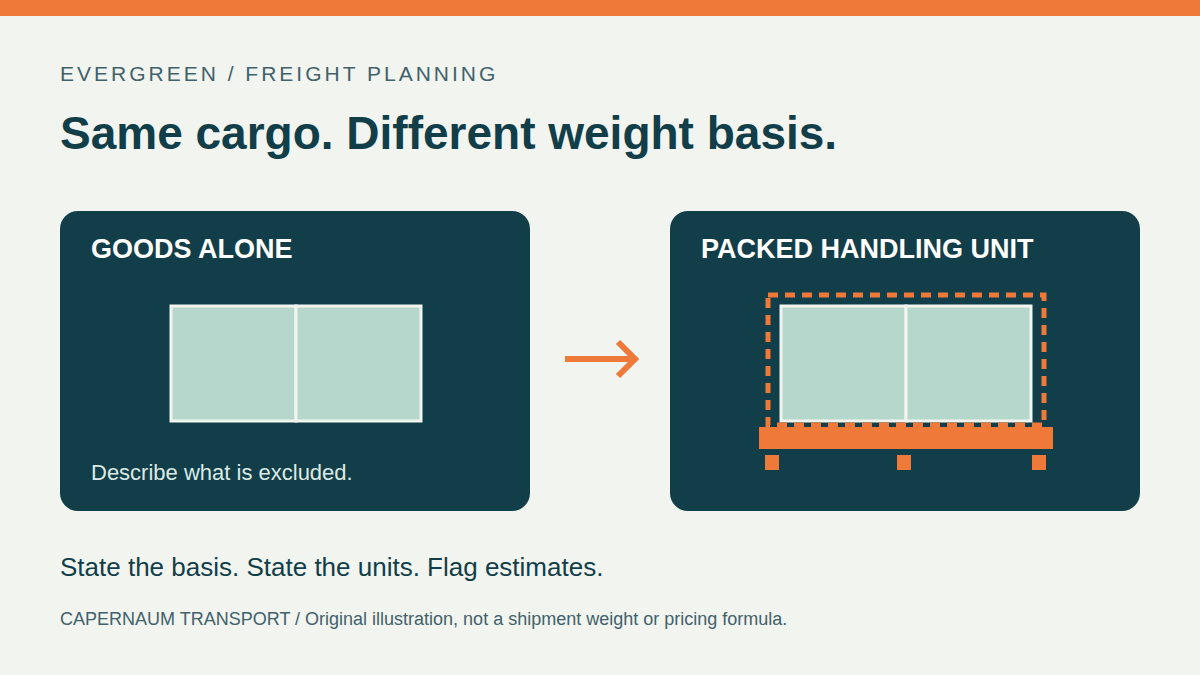
Evergreen logistics explainer. Freight weight needs a description as well as a number. A product-only figure and the weight of a packed pallet describe different things. Before requesting a pickup or comparing a quote, make clear what was included in the number supplied to the transport coordinator.
This guide offers a practical weight handoff for ordinary shipment planning. It does not report current rates, prescribe a freight classification, establish equipment limits or explain customs filing requirements. A provider must confirm the weight information and other details needed for the actual movement.
Separate the goods from the packed handling unit
The International Trade Administration’s Common Export Documents reference lists total net and gross weight among the details on an export packing list. It also identifies package counts, package types and, where appropriate, dimensions. A weight field therefore belongs with a description of the cargo and its packaging, not in isolation.
The U.S. Census Bureau’s foreign-trade definitions illustrate why context matters. Its air shipping weight definition includes wrappings, crates and boxes, while its primary-quantity discussion distinguishes net weight from barrels, boxes and other bulky coverings. These are definitions for particular trade statistics, not a universal truck-booking or billing rule. The useful planning lesson is to name the basis rather than assume every field called “weight” means the same thing.
For an inland freight conversation, our recommendation is to distinguish the goods alone from each complete handling unit as offered for collection. State explicitly whether the pallet, crate, protective material and other packaging are included. If the source record does not say, ask its owner instead of relabeling the figure as a measured packed weight.
Send five pieces of information together
- Handling unit: identify the specific pallet, crate or other unit the figure describes.
- Weight basis: say what is included and what is excluded. Avoid using an unexplained “net,” “gross” or “total” label alone.
- Unit of measure: put kilograms or pounds beside the number, including in a spreadsheet export or email.
- Measurement status: distinguish a measured result from an estimate, catalog figure or calculation. Identify when the packed unit was checked.
- Shipment total: reconcile the handling-unit entries with the stated total and count. Do not hide a missing unit behind one shipment-level number.
This is our suggested coordination record, not a carrier form or legal reporting standard. Ask the provider which fields and supporting information apply to the shipment, and keep the provider’s confirmation with the booking.
Use an example without turning it into a quote
Consider a fictional pallet with 800 kilograms of goods, a 25-kilogram pallet and 15 kilograms of packaging. The stated components add to 840 kilograms. In that example, “800 kilograms of goods” and “840 kilograms including pallet and packaging” are both meaningful descriptions, but they are not interchangeable.
The arithmetic is illustrative, not a measured shipment or a billable-weight calculation. Do not apply the example’s pallet or packaging weights to another load. If the complete unit has not been weighed, identify the result as calculated and ask what verification the provider needs. A product catalog cannot establish the actual weight of a newly packed pallet.
Recheck the basis after packing changes
Splitting a pallet, adding a crate or changing protective material changes what the handling-unit record describes. Our operational recommendation is to check the affected entries before using the old total in a new booking request. Keep the old and new records distinguishable, and send the updated count and weight basis to the person arranging transport.
Weight is only one part of that discussion. Supply the actual packed dimensions, commodity, origin, destination and receiving needs as well. Do not infer a vehicle’s suitability, a freight class, a safe lifting method or a final charge from a weight total alone.
Our packing-list guide focuses on connecting package identifiers with contents. This explainer focuses on a different check: what a weight number includes. To discuss freight with Capernaum, share the shipment facts and clearly identify anything still estimated. Availability, equipment, service scope and charges need shipment-specific confirmation.
References and scope
Published 2026-11-04. Both linked government reference pages were directly checked November 4, 2026; they are reference material, not new news releases. ITA supports the distinction between net and gross weight fields and associated packing-list details. Census supports the limited, context-specific examples of included packaging and excluded bulky coverings described above. The five-field handoff, packing-change check and fictional arithmetic example are original editorial recommendations. They do not replace carrier instructions, weighing procedures, tariffs or professional advice. No customer records, source prose or publisher imagery are reproduced.