
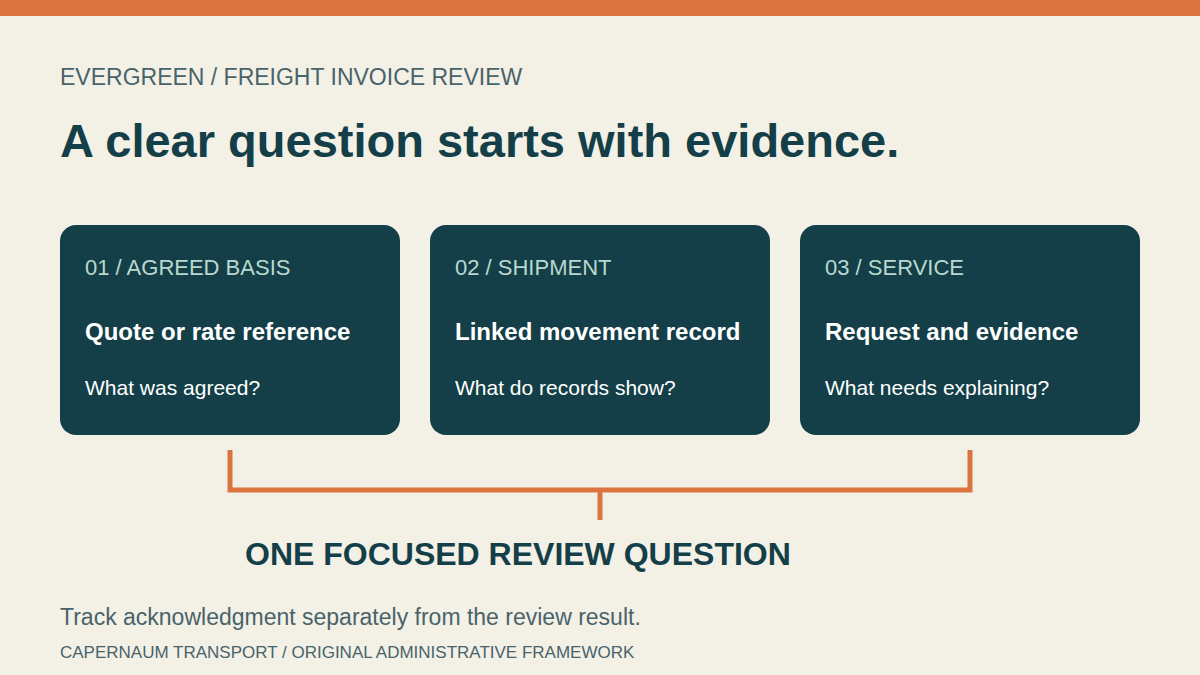
Evergreen logistics explainer. A freight invoice review works best when it starts with a specific charge and the records needed to explain it. Sending an invoice with the message “this looks wrong” leaves the reviewer to reconstruct the booking. A compact evidence packet can make the question clearer without assuming that every difference is an error.
This is an original administrative coordination guide for domestic freight. It does not decide whether a charge is owed, interpret a tariff, set a filing deadline or recommend withholding payment. Follow the applicable agreement and the selected provider instructions for the actual shipment.
Separate the quoted plan from the billed shipment
A quote records the terms offered for a described move. The invoice needs to be reviewed alongside what was booked and what the shipment records show. Our recommendation is to preserve the accepted quote or rate reference, the shipment identifier and the invoice version together before asking for a correction. Do not silently replace an earlier record with a revised one.
The Estes freight FAQ explains that its invoices may change to reflect reweighs on certified scales, shipment dimensioner results or classification standards. That is an attributed description of one carrier practice, not proof that a particular invoice is correct or that every provider follows the same process. It supports a narrower practical point: a difference from the original paperwork needs an explanation, not an automatic conclusion.
Build three evidence groups
The following is our proposed review format, not a prescribed carrier form:
- Agreed basis: Keep the accepted quote or applicable rate reference, its date, the service description and the shipment assumptions supplied when booking. Identify which reference you believe applies rather than attaching an unrelated earlier estimate.
- Shipment record: Link the bill of lading and relevant pickup or delivery records to the invoice shipment identifier. Record the units used for weights and dimensions. If there is a reported remeasurement, request the supporting record rather than guessing how the difference arose.
- Service evidence: For a questioned service charge, identify the service named on the invoice and the available request, response or performance record. Keep a missing record marked as missing. Absence from your folder alone does not establish that the service did not occur.
Share only the records needed for the question through the agreed private channel. Keep credentials, unrelated customer material and private account information out of broadly circulated email chains or public links.
Write one question for each disputed line
For each item, record the invoice line description, billed amount, reference you are comparing it with, the difference you want explained and the supporting attachment. Use neutral wording: “Please explain the basis of this line against the attached booking reference” is more useful than asserting an unsupported billing error.
For example, imagine a fictional shipment whose invoice contains a weight different from the booking record. The review packet would pair the original packed-weight record with the invoice and ask for the basis of the billed weight. It would not claim that a new invoice weight must be wrong, invent a scale result or calculate an unsupported refund. This is an illustrative workflow, not a customer case.
Keep separate questions separate. A weight question, an additional-service question and an invoice-routing question may need different evidence. Our freight contact role guide helps identify who handles billing versus service approval. This article addresses a different step: assembling the records needed to review a specific charge.
A submission receipt is not a resolution
The Estes rating and billing discrepancy FAQ describes an online submission process with a confirmation email and supporting-document options for logged-in users. Its follow-up FAQ separately describes acknowledgment and the later review result. These are carrier-specific examples, not a promise about Capernaum response times or a universal dispute procedure.
Our recommendation is to track three distinct states: packet prepared, inquiry submitted with its acknowledgment, and response received. Record any requested additional evidence and the person responsible for obtaining it. Do not mark the matter resolved simply because a form was accepted or an email was delivered. If a revised invoice is issued, retain both versions and check whether the response actually addresses the original question.
To discuss a freight move with Capernaum, provide the cargo, origin, destination and requested timing. Any shipment-specific billing review should use the agreed private route with the relevant provider; this explainer does not promise an audit service, adjustment or outcome.
References and scope
Published 2026-11-12. The linked Estes freight FAQ sections were directly checked November 12, 2026. They are undated reference pages, not a news release. The weight/class section supports only the attributed explanation of possible invoice changes. The discrepancy and follow-up sections support only the attributed distinction between submission acknowledgment and a later review result. The three-group packet, neutral-question format and fictional example are original editorial recommendations. No rates, legal liability, regulatory interpretation, deadlines, capacity, client facts or third-party artwork are asserted or reproduced.