
Evergreen logistics explainer. Freight timestamps need more than a clock reading. When a shipper, warehouse and transport coordinator compare updates, “arrived at 09:00” leaves an important question unanswered: 09:00 where? Keep the event, calendar date and time basis together before comparing two records or passing along a receiving instruction.
A local clock reading is not a complete timestamp
RFC 3339, Date and Time on the Internet, describes timestamps with an explicit relationship to Coordinated Universal Time, or UTC. Its numeric offset expresses local time minus UTC. This is a technical reference for Internet timestamps, not a freight tariff or a requirement that every shipment document use one format.
For a coordination note, our recommendation is to retain the facility's full date and local time, its named time zone when confirmed, and the date-specific UTC offset when exchanging a precise event time across systems. Also record what happened and who supplied the time. Do not replace an unknown time zone with the coordinator's own computer setting.
Two different dates can describe the same instant
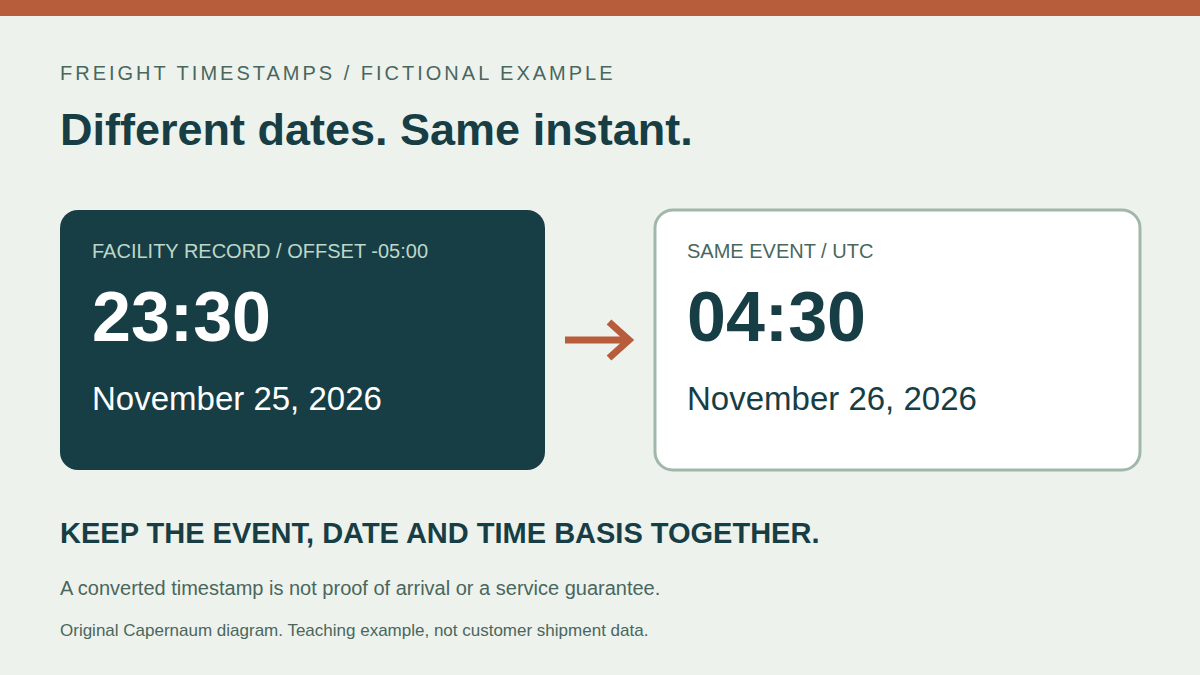
Fictional example: a receiving record says 2026-11-25T23:30:00-05:00. A tracking export shows 2026-11-26T04:30:00Z. These represent the same instant: adding five hours to the local clock reading crosses midnight in UTC. The shipment did not necessarily arrive a day late because one display shows November 26.
The example uses an explicitly supplied offset, not an assumption about a real customer's location. Before treating different calendar dates as a service exception, check both records' time bases and the event each describes. An arrival report, a check-in scan and an unloading completion report are different milestones even when they concern one delivery.
Keep the original values alongside any conversion. Converting a timestamp can make comparison easier, but it cannot prove the underlying event occurred, establish which milestone a scan represents or correct a source clock that was wrong.
Use the offset for the actual date
NIST's daylight saving time reference explains that clocks move forward in spring and repeat an hour when daylight saving time ends in places that observe it. It also identifies places that do not observe daylight saving time. A fixed hour difference copied from an earlier shipment is therefore not a dependable substitute for checking the relevant location and date.
If an overnight event falls within a repeated local hour, ask the source to confirm the offset or provide an unambiguous system timestamp. If an appointment message contains a local time that does not exist during a spring clock change, have the receiver clarify the intended slot. Do not silently choose an interpretation and send it to dispatch as confirmed.
This is a data-quality check, not advice about transport regulations or a prediction that time rules will remain unchanged. NIST notes that local-time corrections depend on operating-system settings and updates. For future appointments, confirm the receiver's local instruction for that date rather than treating an old conversion as a standing rule.
Keep a readable handoff note
A compact coordination note can contain the following fields. This is our suggested working format, not a carrier-mandated form:
- Event or instruction: State whether the value is an accepted appointment, estimated arrival, actual arrival or another named milestone.
- Facility date and time: Write the full date and use an explicit 24-hour time or AM/PM designation.
- Time basis: Record the confirmed location/time zone and, for a precise timestamp, the applicable UTC offset. Mark missing information as unconfirmed.
- Source: Identify the message or system and whether the value was supplied directly or converted.
- Comparison value: If useful, add the equivalent UTC timestamp without deleting the original record.
When two updates appear out of sequence, first compare like milestones on the same time basis. If a conflict remains, preserve both records and ask the responsible party to clarify it. Do not backfill an actual arrival from an estimate simply to complete the timeline.
Separate the clock question from the service agreement
Our delivery date and receiving-window guide explains the difference between a requested deadline and a confirmed appointment. This explainer addresses a narrower problem: reading and comparing the times attached to those instructions and events. A precise timestamp does not establish that a slot was accepted, a guarantee was purchased or a fee is owed.
For a drayage, cross-dock or regional freight discussion with Capernaum Transport, provide the cargo, origin, destination and timing constraints. Include the receiver's confirmed local time basis when timing matters. Ask for shipment-specific scope and availability rather than assuming a timestamp format creates a service commitment.
References and scope
References checked November 25, 2026 (2026-11-25): RFC 3339, July 2002, sections 4.2 and 5.6, supports numeric UTC offsets and timestamp notation; NIST, Daylight Saving Time Rules, updated February 9, 2026 (2026-02-09), supports clock-change behavior, exceptions and software-setting context. The handoff format, freight applications and fictional conversion example are original editorial analysis. This evergreen logistics explainer reports no new event, live market reading or guaranteed service result, and offers no tariff, claims or regulatory interpretation.