
Evergreen logistics explainer. Freight units of measure belong beside every quantity. “24” could mean individual products, cases or physical handling units. Even when both teams write “cases,” the conversion to individual items still needs a product-specific answer. Before a warehouse delivery or onward distribution move, agree what is being counted and how the receiving team should translate it.
Separate the quantity from the conversion
Microsoft's units-of-measure documentation distinguishes standard conversions from product-specific conversions and describes both conversion factors and rounding settings. That distinction matters at a freight handoff: a familiar abbreviation does not, by itself, establish how many products belong inside a case.
For an illustrative product A, one case might contain 12 individual items. For product B, one case might contain 8. These are invented teaching quantities, not industry standards or customer records. Applying A's factor to B would turn 10 cases of B into a record of 120 items instead of 80. The arithmetic is easy; identifying the correct factor is the real control.
Build a product-specific conversion brief
Our operational recommendation is to confirm a short conversion brief with the party that owns the product and packaging data. Keep these fields together:
- Product and pack configuration: identify the exact item and the packaging version being shipped, not just a generic description.
- Quantity and unit: write “10 cases,” not an unexplained “10.” Define abbreviations when partners use different vocabularies.
- Conversion direction: state “1 case = 8 each” rather than an isolated factor of 8 whose direction is unclear.
- Basis and confirmation: record who supplied the factor, which product record or specification supports it, and whether the receiving team agrees.
- Partial-unit treatment: specify how remaining individual items will be shown instead of rounding them into a fictional full case.
This brief is an original coordination checklist, not a universal warehouse specification. Ask the actual receiving facility which units its process accepts. Do not change a partner's system configuration merely to make the paperwork totals look consistent.
Keep whole cases and remaining items visible
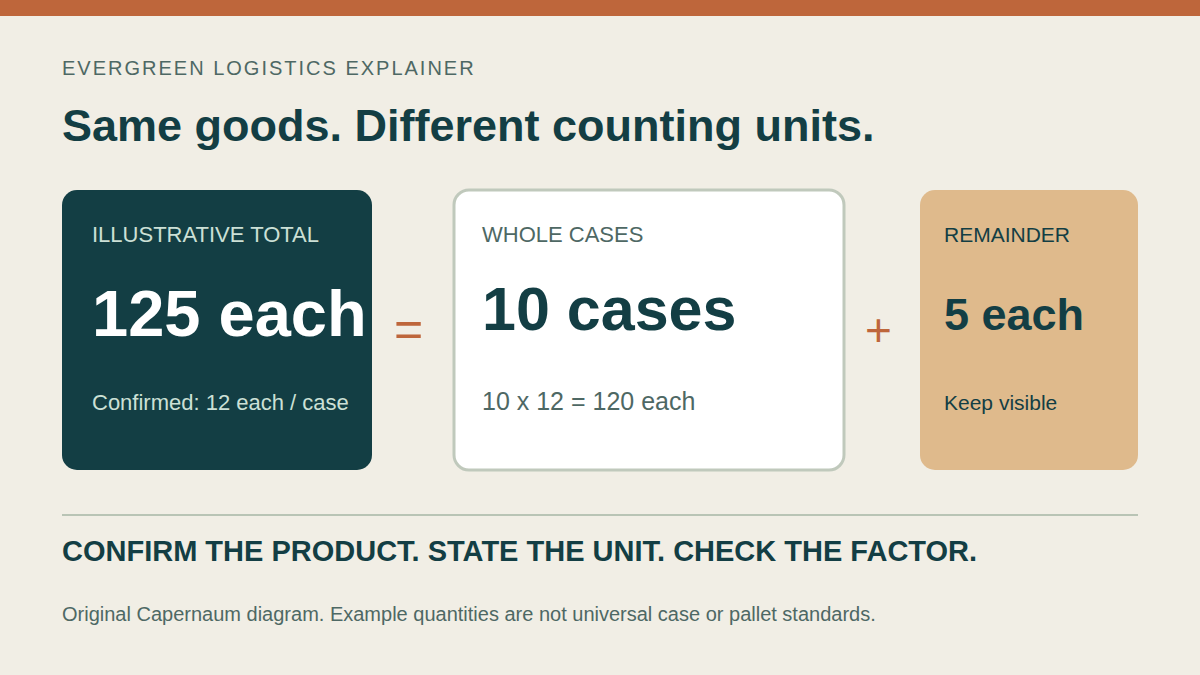
Illustrative calculation: with a confirmed factor of 12 each per case, 125 each equals 10 full cases plus 5 each. It does not equal 11 full cases. If a screen displays a rounded decimal case quantity, retain the underlying count and confirm how the next team will record the remainder.
Microsoft's unit sequence group guidance describes a product's hierarchy of warehouse units and the conversions between them. In that software, warehouse work can use different units depending on whether a quantity converts to a whole number. This is a documented software example, not a claim that every warehouse operates that way. The broader operational recommendation is to agree the unit and remainder treatment before comparing totals.
A pallet count does not establish a product count
Two physical pallets can carry different case quantities. Our recommendation is to report handling-unit counts separately from product quantities, then connect them through the actual packing record. Do not multiply every pallet by a remembered “standard” case count unless that configuration has been confirmed for this product and this load.
Packaging configurations can also change. The GS1 pack/case quantity rule treats changes in case contents or predefined pallet case quantities as changes requiring a new GTIN at the relevant higher packaging level. That is a GS1 identification rule, not a new transport regulation. For this handoff, the practical recommendation is to verify the applicable pack configuration rather than carrying an old conversion forward by habit.
Compare like with like before calling a shortage
If one record says 10 cases and another says 120 each, first check the item, the confirmed conversion factor and any partial units. A unit mismatch alone does not establish missing cargo. Preserve the original quantities and clarify the conversion with the responsible parties before changing the record.
Our advance shipping notice guide covers the separate comparison between expected and observed freight. This explainer addresses the counting vocabulary used on either side of that comparison. For an inland move, share physical pallet or carton counts, packed dimensions and weights alongside product quantities when discussing requirements with Capernaum Transport. Inventory conversion, item-level counting and system integration should not be assumed to be included in transportation service.
References and scope
References checked November 17, 2026 (2026-11-17): Microsoft Learn, Manage units of measure, documentation dated June 22, 2026, supports conversion types, factors and rounding; Microsoft Learn, Set up unit sequence groups, documentation dated October 5, 2026, supports warehouse-unit hierarchies and the described software example; GS1, Pack/case quantity, an undated reference page, supports the packaging-configuration distinction and attributed identification rule. The conversion brief, remainder examples and handoff checks are original operational analysis. This evergreen article reports no new event, current market conditions, rates or guaranteed service outcomes.