A reported Gemini Suez routing change is a reason for U.S. importers to check their own bookings, not to assume their containers will arrive sooner. FreightWaves reported on November 17 that Maersk and Hapag-Lloyd plan to return three Gemini Cooperation Asia-Europe services, AE1, AE2 and AE3, to the Suez route instead of the Cape of Good Hope diversion.
What the report says, and what it does not establish
According to FreightWaves, the transition is phased across December and January. Its report identifies AE2 as the first service scheduled to change, followed by AE3 and AE1. It also says implementation depends on continued regional stability and security monitoring. These are reported plans, not confirmation that every affected voyage has already changed route.
The geographic distinction matters. The announcement described in the report concerns Asia-Europe services. It is not, by itself, an announcement that a particular U.S.-bound container has a new routing, a confirmed earlier arrival or a different inland delivery appointment.
FreightWaves discusses possible effects on vessel deployment beyond those services. We do not translate that possibility into a U.S. capacity forecast, an ocean-rate prediction or a promise of faster delivery. A network announcement and the actual instructions for an individual shipment are different pieces of information.
For U.S. importers, start with the booked movement
Our operational recommendation is to ask the booking provider whether the reported change affects the actual service and voyage carrying your freight. If it does not, keep the shipment plan tied to its own confirmed information. A general industry headline should not become an instruction to reschedule a truck.
If a provider does issue a shipment-specific update, identify what changed: the ocean service, a transfer connection, the estimated arrival or the next confirmed action. Keep the previous version and record who supplied the replacement. This is a coordination recommendation, not a carrier requirement or a description of a disruption affecting any Capernaum customer.
Keep three checkpoints separate
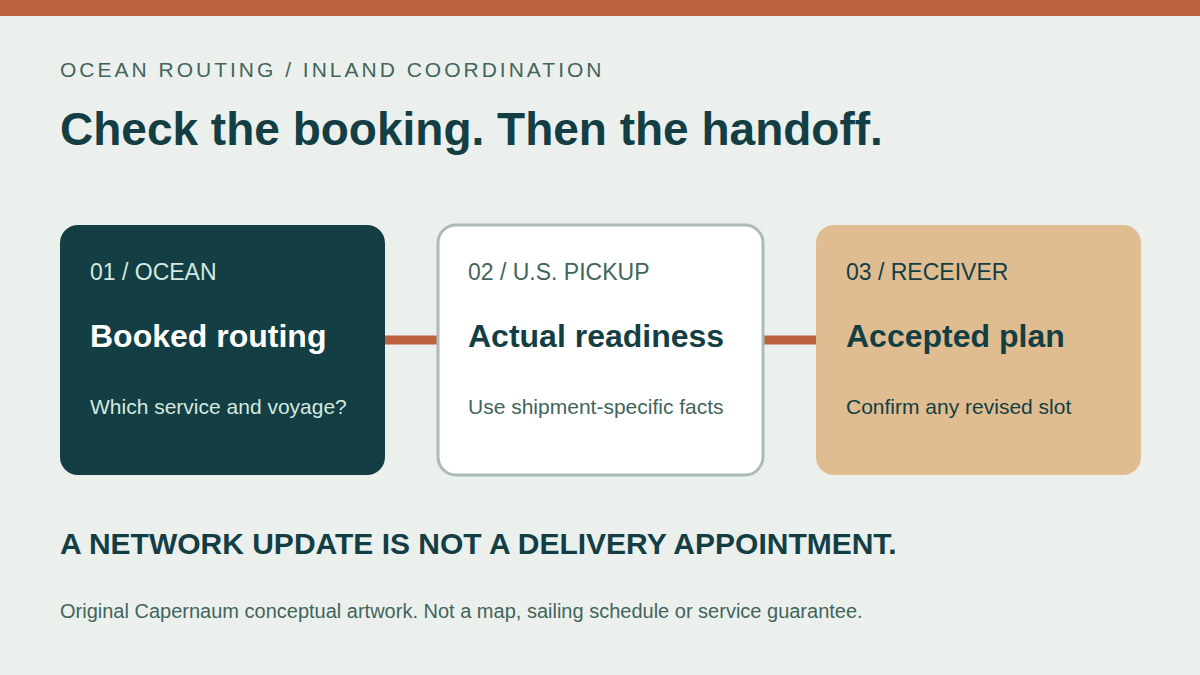
- Ocean routing: Which service and voyage is actually booked, and has the responsible provider confirmed a change for that shipment?
- U.S. pickup readiness: What shipment-specific information will the team use to decide that the next inland move can be arranged? Do not infer readiness from an overseas routing announcement.
- Receiver acceptance: If the arrival plan changes, who checks whether the warehouse can accept the proposed delivery and confirms any revised appointment?
The useful output is a short, current handoff note: the shipment reference, the latest provider update, the next action and its owner. Mark an estimate as an estimate and a proposed appointment as proposed until the responsible party confirms it.
A shorter overseas route is not an inland booking
For teams arranging drayage, a warehouse transfer or regional distribution, the practical issue is whether the shipment-specific plan has changed enough to require a new instruction. Keep truck scheduling and receiving coordination attached to that plan, rather than to an assumption about what the broader network change might eventually do.
For more on that distinction, see our guide to delivery dates and receiving appointments. To discuss a freight movement with Capernaum, share the cargo, origin, destination, timing and latest confirmed handoff details. This article does not imply affiliation with either ocean carrier or a guarantee of capacity, transit time or rates.
Sources and reporting scope
Published November 18, 2026. Source: FreightWaves, “Maersk and Hapag-Lloyd restore Asia-Europe Suez routes as U.S. shippers watch capacity and costs,” published 2026-11-17, checked November 18. The accessible full report supports the named services, planned phased transition and conditional implementation described above. Direct carrier verification was not obtained: the Maersk advisory index failed to load, a bounded alternative path returned 404 and Hapag-Lloyd's news page returned 403. Routing details remain attributed to FreightWaves; we do not claim to have independently confirmed a customer advisory or tested a sailing schedule. We omit rate forecasts, quantitative capacity claims and security interpretations. All operational recommendations and conceptual artwork are original. No publisher prose, photographs or graphics are reproduced, and no interviews or personal reporting are implied.