
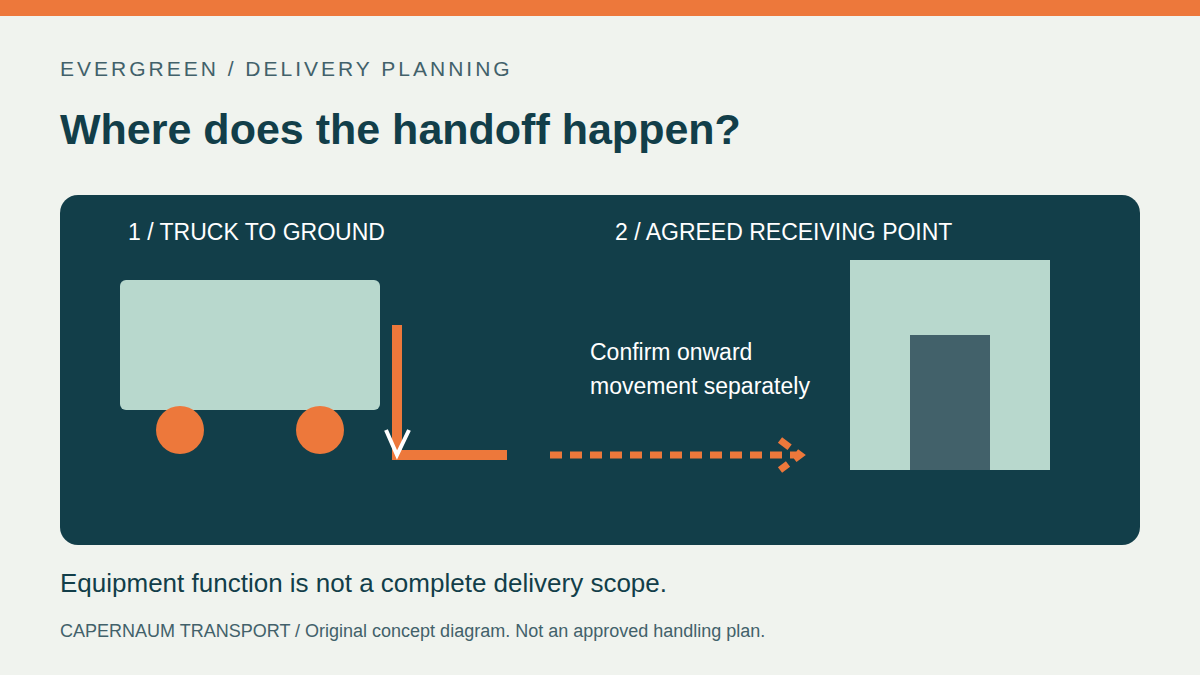
Evergreen logistics explainer. A liftgate delivery request answers an equipment question, but it should not be used as shorthand for the entire unloading and receiving plan. Before booking, separate the transfer between truck and ground from the agreed location where the shipment will be handed over.
Our recommendation for shippers arranging LTL or regional delivery is simple: describe the receiving point in plain language, then ask the provider to confirm the equipment, labor and movement included. A location name such as “store delivery” or a note saying “no dock” is a starting fact, not a complete service specification.
What the liftgate definition actually covers
The Estes transportation glossary describes a lift gate as a powered tailgate that raises or lowers freight between street level and the truck or trailer floor. That is a vertical-transfer function. It does not, by itself, describe an onward route through a doorway or to a receiving room.
The same glossary treats inside pickup and delivery separately, describing service to locations other than the shipping dock. These are carrier reference definitions, not a determination of what any particular quote includes. The applicable provider must explain its own service scope and terms.
Describe the endpoint before selecting the service
For planning, ask the receiver where the shipment needs to end its delivery movement. Is the requested handoff outside the building, at a receiving entrance or at another specific location? Write that location in the request instead of assuming the carrier and receiver mean the same thing by “delivery.”
Then distinguish what the site has from what it needs. Report whether a usable dock is available, what unloading equipment the receiver says it has and whether the receiver will provide personnel. Share known access conditions, including steps, thresholds, surface changes or restricted vehicle access. Ask the provider which details it needs to assess the movement. Do not infer equipment suitability or safe handling from a short checklist or a photograph.
If the receiver expects unpacking, placement, assembly or packaging removal, list those as separate requests. Do not imply that a liftgate selection confirms any of them. This is a recommendation to clarify the request, not a statement that every carrier offers these tasks or categorizes them the same way.
A fictional delivery with an unanswered second step
Imagine a distributor sending one packed pallet to a small business without a loading dock. The receiver wants the goods at a stockroom entrance beyond the exterior delivery area. The booking note says only “liftgate required.”
That note identifies a possible truck-to-ground requirement, but leaves the onward movement unresolved. A clearer request would identify the packed unit, its dimensions and weight, the proposed unloading area, the requested stockroom handoff point and who is expected to move it between those locations. The provider can then confirm what it can perform, what information is missing and what service or charge applies.
This is a fictional coordination example, not a real shipment, a safe unloading procedure or a promise that the proposed route is workable. The correct answer may be a different receiving arrangement rather than adding a service label.
Keep scope, authorization and price together
Our suggested confirmation record has five fields: requested handoff point; provider-confirmed included work; receiver responsibilities; unresolved site questions; and who can authorize a change. Keep the confirmed scope with the booking details so the receiver and coordinator can use the same arrangement.
Estes’ accessorial-preauthorization FAQ illustrates why approval contacts matter: for its service, it calls for an authorization contact on the bill of lading when preauthorization is required, and warns that an inability to obtain a response can delay the shipment. That is an Estes-specific reference, not a universal instruction for every carrier. Ask the selected provider how its approval process works.
Do not publish or assume a standard liftgate price, weight limit, delivery distance or labor allowance from this guide. Those details require the actual provider’s terms and shipment-specific confirmation. A requested service is not the same as a confirmed service.
Before confirming the booking
- Name the requested physical handoff location, not just the street address.
- Provide the final packed unit count, dimensions, weight and known handling restrictions.
- Describe dock availability, receiving equipment and known access conditions accurately.
- Ask who performs the movement after the truck-to-ground transfer, if any.
- Confirm included work, exclusions, charges and the process for approving changes.
For the measurement side of the brief, see our packed freight dimensions explainer. To discuss a move with Capernaum, share the route, cargo, timing and receiving conditions. Service availability and scope require confirmation; this article does not announce an inside-delivery or installation offering.
References and scope
Published 2026-11-06. The linked Estes glossary and FAQ are undated reference pages directly checked November 6, 2026, not new releases. The glossary supports the liftgate function and separate inside-service definition. The FAQ supports only the named carrier’s preauthorization example. The handoff questions, confirmation record and fictional example are original editorial recommendations. No universal tariff, safety procedure, regulatory interpretation, rate or capacity claim is made. No source prose, third-party images or customer information is reproduced.