
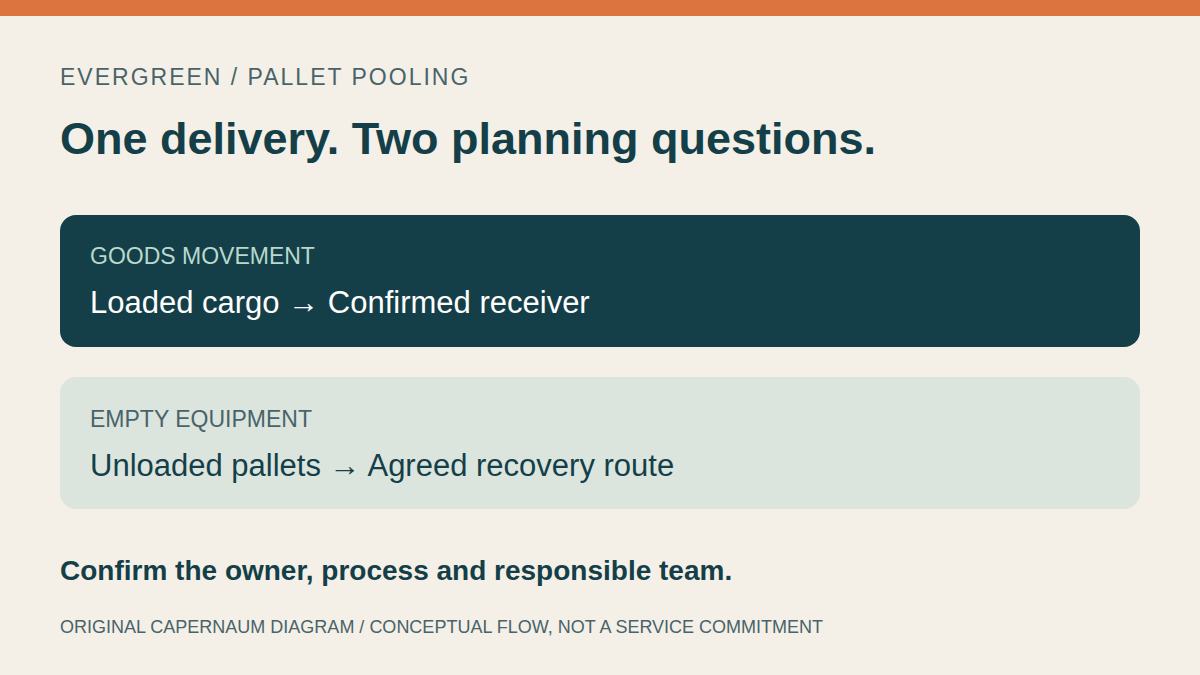
Evergreen logistics explainer. Pallet pooling means that the platform under the goods can have a journey of its own. Before booking a delivery, separate two questions: where does the cargo go, and what is the agreed plan for the pallet after unloading?
A shipment described as “palletized” does not answer that second question. This guide explains the pooling model using two providers’ public descriptions, then offers an original planning checklist. It is not a new market announcement, a pallet-rental offer or a statement that Capernaum manages a pool operator’s equipment accounts.
What pallet pooling means
CHEP describes its system as renting platforms rather than owning them, with collection, inspection, repair and reuse managed through its network. Its published pallet workflow includes the customer loading and shipping goods, reporting the shipment through myCHEP, and CHEP arranging pallet pickup and return to its service center.
PECO independently describes pallet pooling as a rental system. Its explanation follows the same broad cycle: supply pallets, ship the loaded product, recover the pallets, inspect and repair them, then put them back into circulation. PECO also states that its red pallets remain its property. These are descriptions of those providers’ programs, not universal terms for every pallet or every shipment.
The useful operational distinction is between the cargo movement and the equipment-recovery arrangement. A delivery plan should not silently assume that ownership transfers with the goods, that empty pallets are disposable, or that the delivery driver has agreed to take them away. Check the applicable program and shipment instructions instead.
Put an empty-pallet plan beside the delivery plan
The following is our proposed coordination checklist, not a provider’s mandatory form. Ask the shipper, receiving location and relevant pallet-program contact to confirm the answers before treating any return move as booked.
- Identify the equipment arrangement. Record the pallet provider or owner as supplied by the responsible party. Ask whether the pallets are pooled, owned by the shipper, or handled under another arrangement. Do not substitute appearance or dimensions for confirmation.
- Name the recovery route. Will the provider collect empties, will an authorized party arrange a separate move, or is a specific exchange actually agreed? Write down the answer rather than using “return pallets” as a catch-all instruction.
- Confirm the pickup location and readiness. Ask where empty pallets will be held, who can release them, and when they will be available. Keep these details separate from the address and appointment for delivering the goods.
- Assign the reporting task. Establish who handles any program reporting and who confirms that the record was updated. CHEP’s described use of myCHEP is one provider-specific example, not proof that every receiver or carrier uses that process.
- Agree counts and exceptions. Record the expected quantity and how the parties will reconcile the actual empty count or a discrepancy. Ask the provider for instructions on damaged or uncertain equipment rather than inventing a disposal or repair procedure.
- Confirm transport scope separately. If an empty-equipment move is requested, confirm who books it, the agreed timing and any applicable charges before expecting a vehicle to perform it. A loaded-freight quote is not evidence that an additional move has been accepted.
Do not confuse collection with an immediate exchange
Both cited providers describe a recovery cycle. That does not establish a universal promise of a one-for-one exchange at the unloading dock or collection by the same truck. Use the actual provider arrangement and the receiver’s confirmed instructions for the shipment at hand.
For example, imagine a fictional delivery where the shipper expects the pallets to enter the receiver’s pooled-equipment flow, but the receiving note says “driver to collect empties.” The right next step is to resolve the conflicting instruction with the responsible teams before dispatch. Do not turn it into an assumed additional service. This is an illustrative planning problem, not a reported customer case.
A short brief that makes the next action clear
A practical note can state: “Pallet arrangement: [confirmed provider or owner]. Empty-equipment route: [confirmed process]. Recovery location and readiness: [details]. Reporting owner: [team]. Quantity confirmation: [method]. Transport booking status: [requested or confirmed, with reference].” These are suggested fields, not contractual terms or a live booking.
Keep this equipment plan alongside the cargo description, packed dimensions, weight and receiving requirements. Our GTIN and SSCC explainer addresses a different question: identifying the goods or logistics unit. Identification does not, by itself, settle pallet ownership or recovery responsibilities.
For a freight discussion with Capernaum, share the cargo, lane, timing, receiving requirements and any confirmed pallet-recovery instructions. Any additional handling or empty-equipment transport needs its own scope confirmation. No provider affiliation, guaranteed recovery service, price or capacity is implied here.
References and scope
Published 2026-11-14. CHEP’s “How does CHEP work?” page and PECO’s public pooling explanation and ownership FAQ were directly checked November 14, 2026. They are undated reference pages, not news releases. They support the attributed rental, recovery, inspection and reuse descriptions, and PECO’s own ownership statement. The checklist, brief and fictional scenario are original editorial recommendations. Provider terms and shipment-specific agreements control the actual arrangement. No legal, repair, safety or regulatory instruction is offered. Source prose, logos and illustrations are not reproduced.