
Evergreen logistics explainer
Product date fields belong in a freight handoff with their meanings intact. A production date, packaging date, best-before date and expiration date are not interchangeable labels for one generic spreadsheet column called “date.” Preserve which date was supplied before asking a warehouse or receiver to act on it.
This evergreen guide covers information handoffs, not product safety, shelf-life calculations or regulatory advice. It reports no new rule or market event. The suggested workflow is original operational commentary; product owners and receivers must establish any product-specific acceptance requirements.
Four GS1 date fields with different names
The GS1 Application Identifier dataset identifies separate fields for these dates. Its individual reference pages describe:
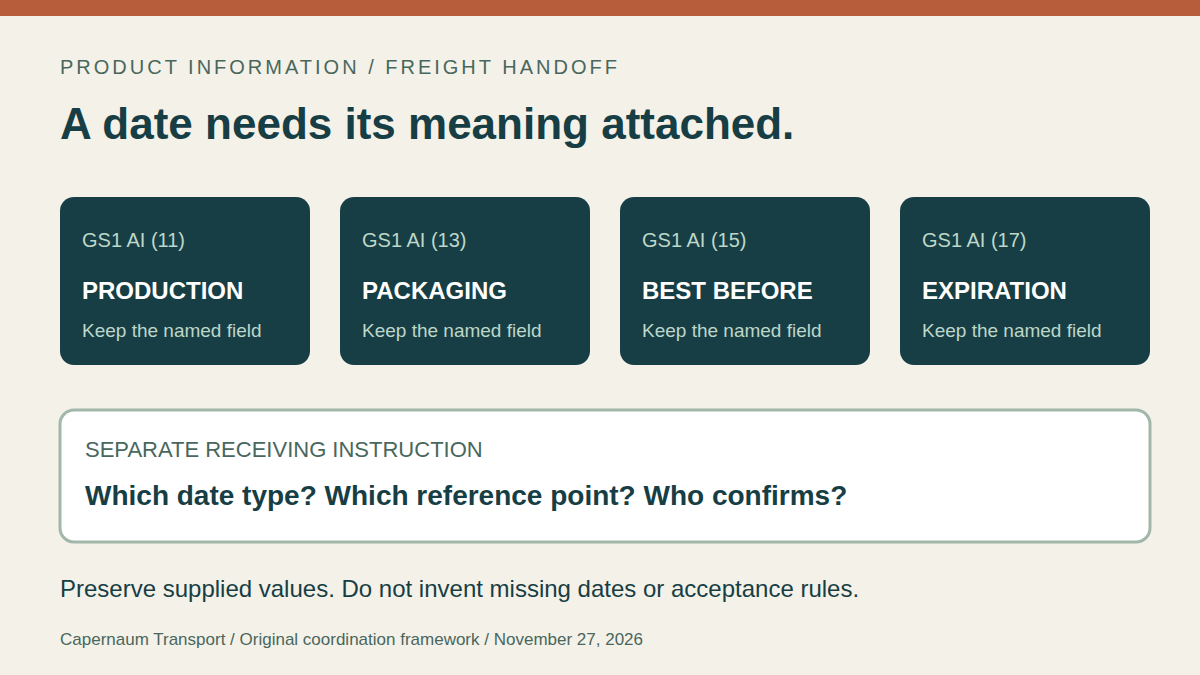
- AI (11): production date.
- AI (13): packaging date.
- AI (15): best-before date.
- AI (17): expiration date.
GS1 lists these four date values in YYMMDD format. That is a statement about these GS1 fields, not a claim that every printed date, supplier spreadsheet or customer portal uses that format. This guide does not cover barcode construction or special date-encoding cases. When an actual label or record is unclear, seek clarification rather than decoding by guesswork.
Keep the date type beside the date value
Our recommended handoff retains the source field name, supplied value, product identifier, relevant lot and the handling units to which the information applies. If a system needs a normalized display, retain the original value as well and document the confirmed meaning of the converted field.
For example, a fictional supplier sends two entries for the same product: one explicitly marked production date and another explicitly marked best-before date. Importing either into an unlabeled “expiry” column would lose information. The useful action is to preserve both named fields, not select the later date or assume that one can be calculated from the other.
This differs from mapping batch and lot contents to pallets. That map identifies which goods are where. A date-field record explains what a supplied date means for those goods. Neither record substitutes for the other.
Separate recorded dates from receiving requirements
A product date is an input to a conversation, not a complete receiving instruction. If a receiver specifies a remaining-life requirement, ask the responsible commercial or product contact to state the applicable date type, reference point and acceptance rule. Do not invent a universal number of days or apply one customer's rule to every destination.
As an original coordination recommendation, write down four things before representing a load as meeting a date-related requirement:
- The product field: exactly which date type and value the supplier provided.
- The receiving instruction: the receiver's stated requirement, including the event or date against which it is assessed.
- The responsible contact: who is authorized to resolve ambiguous or missing product information.
- The recorded answer: what was confirmed and which shipment quantities it covers.
Keep any unanswered condition visibly unresolved. A scheduled delivery, a complete packing list or a successful barcode scan is not, by itself, evidence of receiver approval under a separate product-date requirement.
Do not turn a missing date into an invented one
If a file contains a date but no label, ask what it represents. If a named field is blank, preserve that as missing information rather than copying another date into it. If label and electronic record disagree, send the conflicting values to the responsible contact and retain the response with the handoff.
The same discipline applies when freight is split. Pass the confirmed date information with the affected product quantities and handling units rather than attaching one convenient date to the entire trailer. This is a proposed information-control practice, not a claim that GS1 mandates this particular workflow.
What to include when discussing the move
For a Capernaum freight inquiry, share origin, destination, cargo, quantity and timing, plus any known receiver requirements relevant to the movement. Flag product-date questions still awaiting the responsible party's answer. Do not send an assumed shelf life as if it were a verified shipping instruction.
Transport coordination should preserve the supplied facts and open questions. It should not silently create product-release permission, a storage specification or a promise that a receiver will accept the goods.
Reference and scope note
References checked 2026-11-27: GS1 Application Identifier pages and their linked current JSON-LD dataset for AIs 11, 13, 15 and 17. No article publication date is displayed for these live reference entries; the date above is our check date. Those references support the field names and stated YYMMDD format only. The handoff record, clarification steps and separation of receiving requirements are original operational recommendations. No safety determination, legal interpretation, temperature-control capability or current market claim is asserted.