
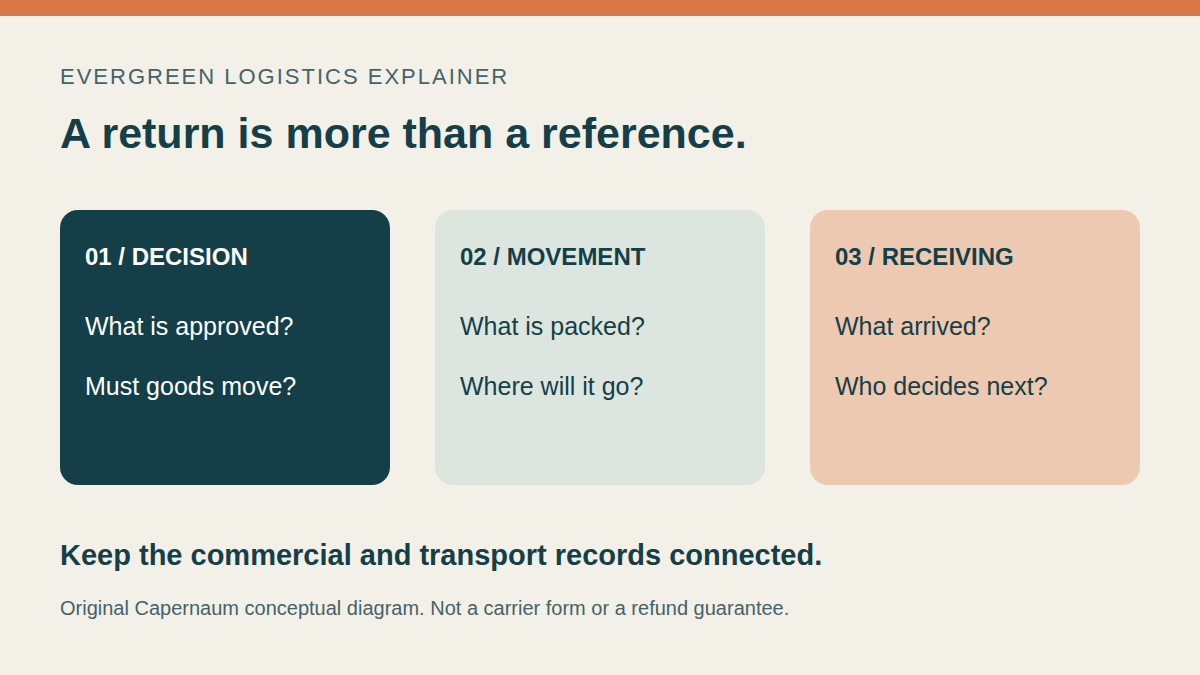
Evergreen logistics explainer. A return merchandise authorization identifies a commercial return, but a freight team still needs a physical movement plan. Before arranging an LTL or truckload return, establish whether the goods should move at all, where they should go and who will receive them. This is process guidance, not a report of a new market event.
Start with the return decision, not the original delivery address
Shopify describes return merchandise authorization, or RMA, as a merchant process for approving and managing a product return. A return authorization number helps connect the returned item with the merchant's records. That is the limited definition used here, not a universal carrier reference format.
Microsoft's Dynamics 365 sales-returns documentation separately describes physical-return and credit-only processes. In its physical-return workflow, arrival, inspection and a disposition decision are separate steps. In its credit-only workflow, products do not need to be physically returned. These are examples from a named business system, not rules governing every seller.
Our operational recommendation is to resolve the first question before asking a provider to collect freight: does this approved commercial outcome actually require a shipment? Do not dispatch goods solely because an order screen contains a return reference.
Build a return-specific cargo and destination record
A return may involve fewer goods than the original order, different packaging or a different receiving location. Treat those possibilities as questions to answer, not assumptions about the shipment. We recommend a short return brief with these fields:
- Approved goods: Identify the items and quantities included in the authorization. Keep items awaiting a decision separate from the confirmed return.
- Freight presented: Record the actual handling-unit count, packed dimensions and weight for collection. Mark anything not yet measured as unconfirmed.
- Return destination: Obtain the accepted receiving address and receiving contact from the responsible return team. Do not automatically reuse the original ship-from address.
- Reference placement: Ask where the receiving team wants its RMA or other return reference shown. Keep it distinct from the transport provider's shipment reference.
- Readiness: Confirm the cargo is packed and available, the collection contact is reachable and the receiving site has accepted the proposed arrangement.
This is our proposed coordination note, not a carrier form. Do not assume an earlier outbound quote covers the return movement or its loading and unloading conditions.
Keep receipt separate from the commercial outcome
Microsoft's documented physical-return process puts inspection and disposition after arrival. Shopify likewise describes checking the returned product before resolving the return. These references support a practical distinction: receiving goods and deciding their commercial outcome are different activities.
In a shipment update, say what the available record actually establishes. A transport delivery record can support an update about the movement. Ask the merchant or authorized returns team for the separate inspection, acceptance or refund decision. Do not promise a credit, replacement or restocking outcome on the strength of a truck delivery update.
If a customer asks, “Has the return finished?”, answer in separate parts: transport status, receiving status and commercial resolution. Leave an unanswered part visibly open rather than compressing all three into “complete.”
Test the plan with a partial-return example
Consider a fictional distributor that received four pallets but has authorization to return selected cartons only. Its RMA identifies the approved items. The warehouse has not yet established the final packed unit count, and the seller has named a returns center rather than the original shipping warehouse.
The useful next step is not to book four pallets back to the old origin. The distributor should confirm the approved contents, prepare and measure the return freight, verify the returns-center instructions and then request the appropriate transport arrangement. After delivery, the commercial team still owns the disposition decision. No customer experience or savings claim is implied by this example.
Give the freight provider the movement facts
For a proposed domestic freight return, send the cargo profile, actual collection and receiving locations, timing, site-access needs and confirmed return reference through the agreed channel. Ask for shipment-specific confirmation of service scope, equipment, availability and price. Keep unnecessary customer and account details out of broadly shared notes.
Our packing-list guide explains how to connect goods with their packages. For a specific movement, contact Capernaum with the verified shipment details. This article does not promise inspection, repair, refund administration or a specialized returns-processing service.
References and scope
Published 2026-11-15. Both linked reference pages were checked November 15, 2026. They are process references, not evidence of a new logistics event. Shopify supports the RMA definition and product-assessment sequence. Microsoft supports the distinction between physical return and credit only, and the separation of arrival, inspection and disposition in its documented system. The return brief, freight handoff recommendations and fictional example are original editorial analysis. No customer records, rates, capacity forecasts, legal interpretation, third-party artwork or software affiliation are asserted or reproduced.