
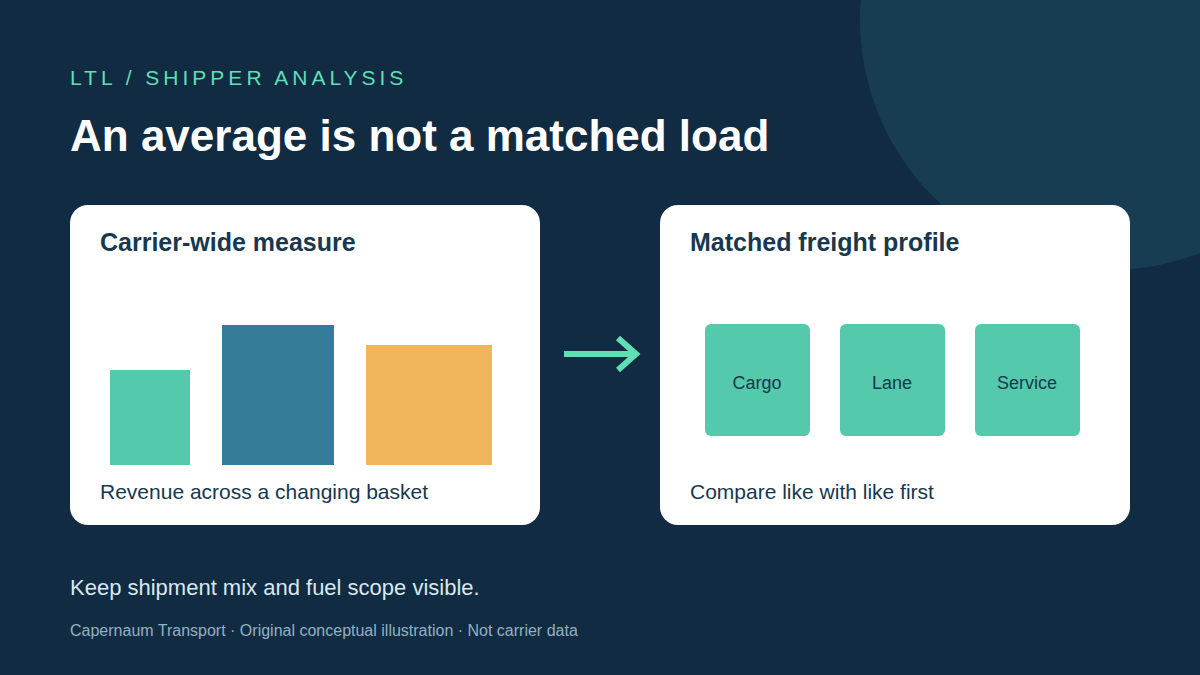
Saia’s LTL revenue per shipment improved in the third quarter, according to Trucking Dive’s November 3 report. The report puts the year-over-year increase, excluding fuel surcharges, at 5.8%, citing the company’s results. For a shipper reviewing less-than-truckload costs, that is a carrier-wide revenue measure, not evidence that the price of an unchanged shipment rose by the same percentage.
Trucking Dive also reports that Saia pointed to pricing and mix optimization in its results, and describes management’s discussion of growth at newer terminals. The useful distinction is between what the carrier earned across its shipment population and what a shipper is being offered for a particular movement. This article does not treat the reported gain as a general rate increase or a forecast for Capernaum customers.
What the reported measure can tell you
Revenue per shipment describes an average: revenue spread across the shipments included in the measure. A change in that average does not, on its own, isolate the effect of price from changes in the freight being moved. If the shipment population changes, a comparison of averages can differ from a comparison of otherwise matching loads.
The fuel exclusion matters too. The 5.8% figure is reported without fuel surcharges; it should not be compared directly with a shipper’s all-in invoice increase and described as the same measure. The report does not establish a universal fuel formula, customer discount or shipment-specific price.
Separate price movement from a different freight basket
Our operational recommendation is to compare a repeatable freight profile before drawing conclusions about price. Keep a separate record of changes in the freight basket: different origins and destinations, cargo characteristics, shipment sizes or requested services. Those changes are questions to investigate, not proof that a carrier caused a particular cost movement.
- Match the movement: use the same origin and destination, and identify any change in the actual pickup or receiving location.
- Match the cargo: compare the stated commodity, packaging, dimensions, weight and handling-unit count. Flag differences rather than treating the loads as identical.
- Match the service: distinguish the requested delivery arrangement and handling needs from a basic transportation comparison.
- Keep fuel separate: compare the same charge categories and the applicable quotation or agreement, rather than mixing a fuel-excluded measure with an all-in total.
- Keep the time basis visible: distinguish a quotation for a future move from an invoice for completed work, and record when each was issued.
This is a shipper-side comparison method, not Saia’s published methodology or a claim about the cause of its quarterly increase. The available reporting does not let us allocate the 5.8% between pricing, cargo mix, geography or individual customer changes.
Use two views in the next freight discussion
Bring both the matched-load comparison and the broader freight-basket summary to a cost discussion. The first asks what changed for comparable work. The second asks whether the work itself changed. Keeping them separate makes a useful question possible: are we discussing a different price for the same requirement, or a different requirement altogether?
Where the records do not support a clean match, state that limitation. Ask the provider to identify the applicable quotation and explain the relevant charge categories. Do not force an explanation from a quarterly headline or assume that every difference is a base-price change.
Our packing-list guide can help organize the package-level cargo information behind that comparison. To discuss a freight requirement with Capernaum, share the actual cargo, lane, timing and receiving needs. Service availability, equipment and price need shipment-specific confirmation. No relationship with Saia or access to its network is implied.
Source and limits
Published November 3, 2026. Source: Trucking Dive, “Saia highlights revenue per shipment gains in Q3,” published 2026-11-03 and directly checked that day. The 5.8% fuel-excluded revenue-per-shipment increase and discussion of pricing and mix are attributed to that report. Its linked Saia earnings release was not independently accessible during verification; it is not counted as an additional confirmation. The comparison framework and explanation of averages are original editorial analysis. No interviews, carrier-specific rate predictions, customer results, source imagery or protected prose are reproduced.