
Evergreen logistics explainer
A serial number handoff answers a different question from a piece count: which individual units are expected, not just how many. For serialized freight, a count can match while the supplied and observed identities differ. Agree the evidence needed before calling a shipment reconciled.
This is an original coordination guide, not a new standard, software implementation instruction or claim that Capernaum provides serial-level scanning. It applies when the shipment parties have agreed to exchange serial information. It does not suggest that every freight movement needs it.
Keep the identifier type attached
The GS1 Application Identifier reference dataset names AI (21) as a serial number, AI (10) as a batch or lot number and AI (01) as a Global Trade Item Number. These are distinct fields. GS1's GTIN reference describes identification of trade items: products or services that are priced, ordered or invoiced in the supply chain.
Our recommendation is to preserve the supplied product reference alongside the serial value and its identifier type. Do not assume a free-standing serial string is a universal key across different suppliers and products. Confirm the agreed matching key with the data owner. This guide does not specify how to assign identifiers or construct barcodes.
Separate expected identities from observed identities
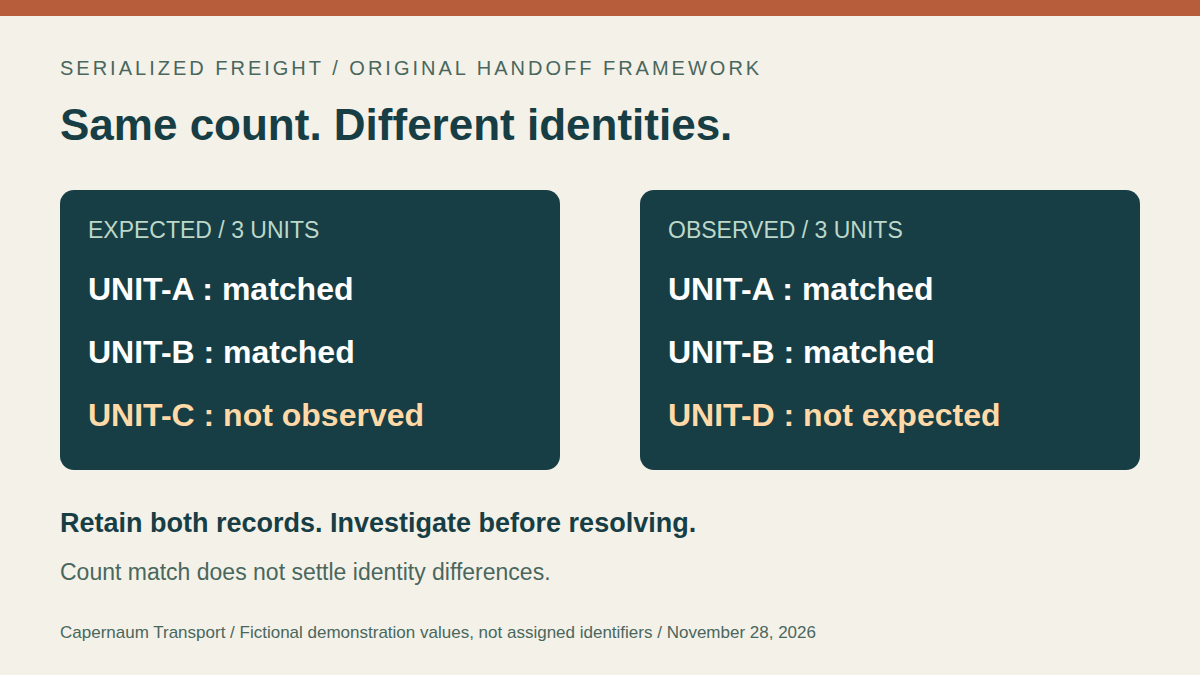
For a fictional shipment, suppose the sender lists three demonstration serial values for one product: UNIT-A, UNIT-B and UNIT-C. The receiving record instead lists UNIT-A, UNIT-B and UNIT-D. Both records contain three units. A quantity-only comparison misses the difference: UNIT-C is expected but not observed, while UNIT-D is observed but not on the expected list.
Those demonstration strings are not assigned GS1 identifiers. The example illustrates a comparison, not proof that goods were lost, substituted or delivered incorrectly. A transcription error, record mismatch or physical discrepancy needs investigation before a conclusion.
Our proposed handoff keeps four separate results: identities matched, expected identities not yet observed, observed identities not expected, and values that cannot be compared reliably. Retain the original records rather than editing the expected list until it agrees with the observation.
Ask when serial capture actually happens
Microsoft's serial-number capture documentation provides a useful system-specific example. In the described Dynamics 365 warehouse processes, configuration can place capture at picking, packing or registration. Under the documented picking or packing settings, inbound receiving does not prompt for that serial number.
This is evidence about that software and configuration, not a rule for every warehouse or evidence of Capernaum's systems. The practical lesson is to ask the actual facility which event produces the serial record. A receiving timestamp or an enabled tracking feature does not explain, by itself, when individual identities were recorded.
Handle duplicates and unreadable values explicitly
As an original operational recommendation, keep an unreadable value unresolved. Do not fill it by copying another unit's serial or inventing the missing characters. If one value appears twice, distinguish a repeated scan or repeated data row from two physically labeled units. A duplicate row alone cannot establish which occurred.
Record the product reference, the supplied or observed serial value, the relevant handling unit, the observation event and the responsible contact. Ask the parties to agree how an exception is resolved and who confirms the corrected record. Preserve the initial observation and the subsequent answer separately.
A count, a lot map and a serial comparison do different jobs
Our batch and lot handoff guide explains how quantities and lots relate to handling units. This article addresses a narrower, different check: whether the expected individual identities match the recorded observations. A matching lot or total quantity does not answer that question.
Before a freight discussion with Capernaum, share cargo, quantity, origin, destination and timing. If serial records are required by a shipment partner, identify the requested capture event, responsible party and exception process. Any additional handling or data arrangement needs shipment-specific confirmation.
References and scope
References checked 2026-11-28. GS1's live dataset supports the attributed identifier names; its GTIN page supports the trade-item definition. These are reference resources, not dated news releases. Microsoft Learn's documentation is dated October 28, 2026 and supports only the described configuration example. The comparison method, fictional scenario and exception record are original editorial recommendations. No regulatory obligation, software compatibility, specialized service, current rate, capacity or customer outcome is asserted.