
TFI truckload and LTL results moved in opposite directions in the third quarter of 2026. That contrast, covered by Trucking Dive on November 6, is a useful reminder for shippers: a transportation group’s overall earnings do not describe every service within it, much less the offer for one load.
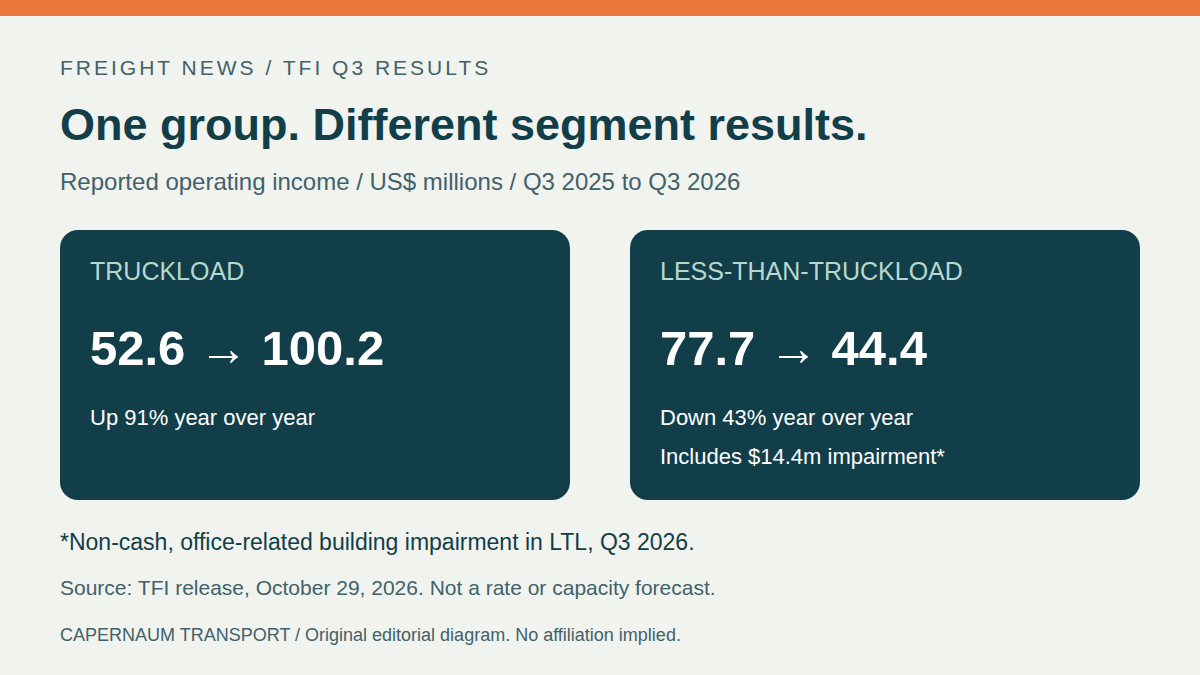
In its October 29 earnings release, TFI International reported truckload operating income of $100.2 million for the three months ended September 30, compared with $52.6 million a year earlier. Less-than-truckload operating income was $44.4 million, compared with $77.7 million. All amounts here are in U.S. dollars.
Read the segment, period and accounting context together
The company reported a 91% increase in truckload operating income and a 43% decrease in LTL operating income. Its LTL results included a $14.4 million non-cash, office-related building impairment charge. That qualification matters: the reported decline should not be described as if it were entirely a change in day-to-day freight operating performance.
Trucking Dive’s November 6 report independently covered the contrast between stronger truckload earnings and weaker LTL earnings, drawing on the company announcement and earnings call. We use the primary release for the exact figures and the impairment context. Neither source establishes a price or a service commitment for a particular shipper.
The revenue comparison also depends on the measure chosen. TFI said total LTL revenue increased 7%, but its segment table shows LTL revenue before fuel surcharge of $677.7 million, compared with $687.0 million a year earlier. Truckload revenue before fuel surcharge was $753.0 million, compared with $684.1 million. Total revenue and revenue before fuel surcharge are different measures; substituting one for the other changes the story.
What this does and does not mean for a freight decision
For a shipper comparing LTL and truckload options, the practical takeaway is to keep corporate performance separate from shipment suitability. These are company-reported quarterly financial results, not a live reading of available trucks, an industry-wide rate index or a statement that one mode is always the better choice.
A stronger truckload segment does not prove that a truck is available on your lane tomorrow. A weaker LTL earnings result does not prove that an accepted shipment will be delayed. The announcement also does not establish that a shipper should move freight from one mode to another or expect a particular discount. Those decisions require a current, shipment-specific response.
Build a like-for-like request before comparing offers
Our operational recommendation is to give each prospective provider the same freight description and constraints. This is original coordination guidance, not a report of changed TFI booking rules.
- Describe the actual freight: Provide handling-unit count, packed dimensions, weight and relevant handling limitations. Use the same basis in each request.
- State the service needed: Identify pickup and delivery locations, receiving hours, appointment needs and any assistance required at either end.
- Separate estimates from commitments: Ask what transit information is being offered and which elements, if any, are expressly committed in the written offer.
- Compare the full scope: Check the quoted transportation, fuel treatment, included services and conditions for additional charges. A corporate earnings percentage is not a customer rate adjustment.
Keep a clean decision record
A useful comparison note states the accepted freight description, proposed service, quoted scope, unresolved questions and the person responsible for confirming them. If the shipment changes, ask whether the existing offer still applies. This gives the next coordinator a shipment-level reason for the choice instead of a general market headline.
Our packed freight dimensions guide explains how to describe the space a handling unit actually occupies. To discuss a move with Capernaum, share the cargo, origin, destination, timing and receiving requirements. Service scope and availability require confirmation. No affiliation with TFI or access to its capacity is implied.
Sources and reporting limits
Published November 7, 2026. TFI International, “TFI International Announces 2026 Third Quarter Results,” dated 2026-10-29, directly checked November 7, supports the reporting period, segment operating income, revenue measures and impairment qualification. Trucking Dive, “TFI International truckload profits eclipse hit to LTL,” published 2026-11-06 and directly checked November 7, provides independent publisher coverage of the same disclosed results, not an independent audit. Financial results remain company-reported. Shipment-planning suggestions are original editorial analysis. No interviews, publisher imagery, investment advice, customer outcomes, rate forecast or capacity guarantee is claimed.