
Tractor Supply’s Uber delivery launch puts the final retail handoff in focus. FreightWaves reported on November 12 that the retailer is adding on-demand delivery through Uber platforms from nearly 2,500 U.S. stores. For businesses coordinating inventory and freight, the useful distinction is between getting goods into a store and getting an eligible customer order out of it.
What the report establishes, and what it does not
FreightWaves describes a collaboration announced Thursday, November 12, allowing customers to order Tractor Supply products through Uber, Uber Eats or Postmates for delivery to their door. It attributes the expansion to the retailer and quotes its digital and e-commerce leadership. We are reporting that account with attribution; we did not independently test an order or verify availability at individual locations.
The announcement is about a retail ordering and delivery channel. It should not be read as confirmation that any particular pallet, oversized item, wholesale order or freight shipment qualifies. The report does not provide the item-level acceptance rules, local delivery boundaries or shipment-specific commitments needed to make those decisions. Check the actual offer for the relevant address, product and time.
Keep two operating legs in the plan
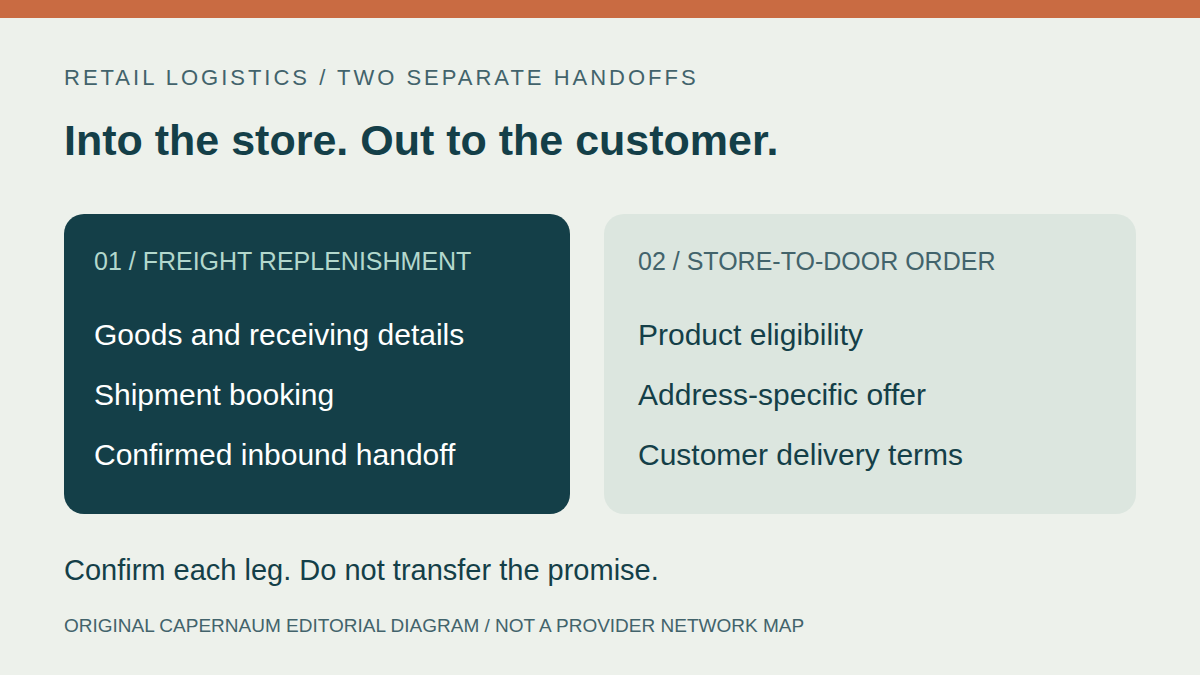
Our planning recommendation is to keep store replenishment and customer delivery as separate workstreams. Replenishment concerns the goods arriving at the retail location: their packed form, receiving arrangements and the freight booking. A customer order concerns what is available for sale and the delivery option offered for that purchase. A promise on one leg does not itself confirm arrangements on the other.
For example, a retailer could advertise a fast delivery option while a supplier is still arranging an inbound freight appointment. That is a hypothetical coordination example, not a reported problem at Tractor Supply. The point is to record the status of each leg instead of turning a consumer-facing delivery headline into an assumed inbound service commitment.
Build a handoff brief, not an assumed service promise
- Identify the inbound move: State the origin, receiving location, cargo, packed dimensions, weight and handling requirements for the freight being booked.
- Confirm the receiving arrangement: Ask the location or its designated coordinator what appointment, reference and unloading arrangements apply. Record the response rather than assuming a consumer delivery option changes receiving procedures.
- Separate stock status from transport status: Keep shipment arrival, receiving completion and the customer-facing availability decision distinct in the working plan.
- Check the actual outbound offer: Verify eligibility and the delivery terms shown for the customer’s order. Do not substitute the nationwide announcement for a location-specific confirmation.
- Name the exception owner: Identify who handles an inbound delay and who handles a customer-order delivery question. Keep any revised commitment attached to the correct leg.
This is our proposed coordination checklist, not a description of Tractor Supply’s internal procedures or Uber’s service rules. It supplies no guarantee of speed, availability, acceptance or pricing. The applicable provider and receiving location must confirm the actual arrangements.
What U.S. freight planners can take away
A new retail channel is a reason to clarify handoffs, not evidence of a specific increase in truckload demand, a change in market rates or a new store replenishment contract. None of those conclusions is established here. Keep any freight proposal tied to the actual goods and receiving requirements rather than a consumer checkout promise.
For related inbound planning, see our warehouse container delivery preparation guide. To discuss a freight move with Capernaum, share the cargo, origin, destination and timing so the appropriate scope can be discussed. No affiliation with Tractor Supply or Uber, customer relationship, or participation in this launch is implied.
Source and reporting scope
Published November 12, 2026. The source is FreightWaves’ November 12 report (2026-11-12), checked the same day; its page metadata records publication at 16:15 UTC. The central launch description is attributed to that accessible independent publication. A directly accessible matching company release was not obtained: the retailer’s corporate newsroom was access-blocked and the checked Uber newsroom route did not provide the announcement. We therefore omit unsupported product rules, coverage guarantees and broader commercial claims. No interviews or personal reporting are claimed. The operational recommendations, wording and illustration are original; publisher text and photographs are not reproduced.