
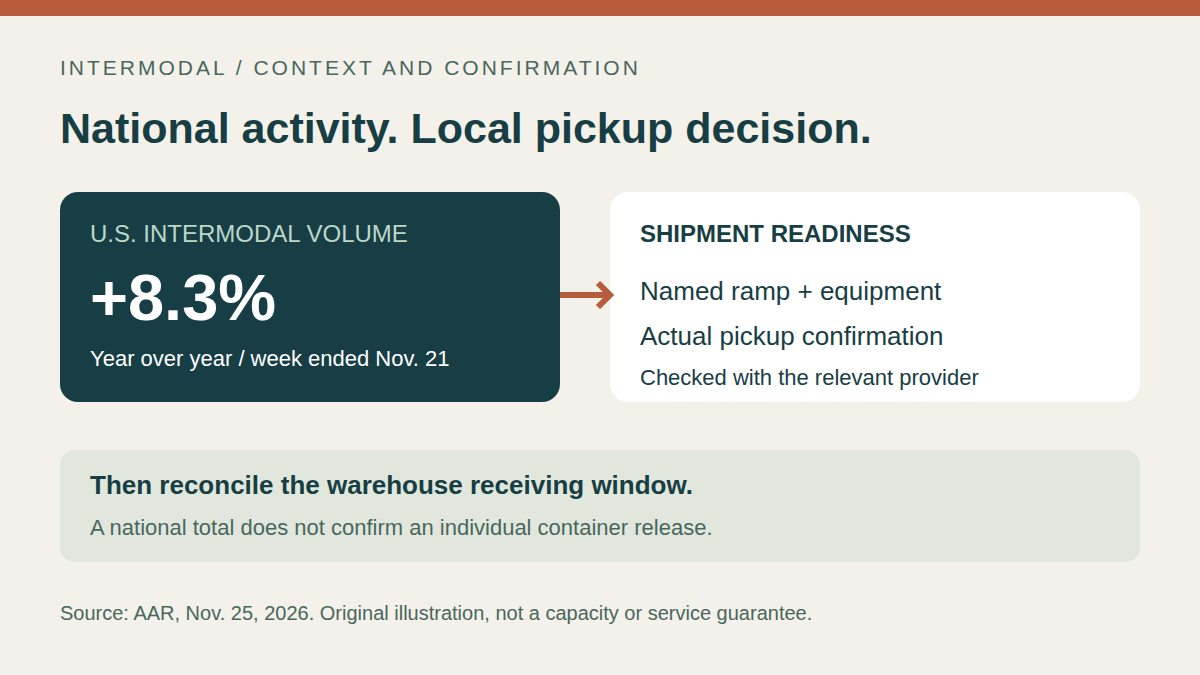
U.S. intermodal volume rose 8.3% from a year earlier in the week ending November 21, according to the Association of American Railroads. That is a useful national activity signal for shippers. It is not a measurement of whether a particular container is available at a particular inland ramp.
What the November 25 release actually measures
The AAR release dated November 25, 2026 reports 304,963 U.S. intermodal containers and trailers for the week. Total U.S. rail traffic, combining carloads and intermodal units, reached 540,111, up 4.7% from the comparable week of 2025. Commodity carloads rose 0.5% to 235,148.
FreightWaves reported the same weekly growth figures on November 27, 2026. Its coverage and the AAR release describe the same dataset, not two separate traffic surveys. The observation week ended November 21; neither publication turns those figures into a Thanksgiving-week reading.
There is an important unit distinction. The intermodal total counts containers and trailers. It is not a TEU total, a count of import containers alone, or a tally of drayage appointments. The combined rail total also includes commodity carloads. Do not relabel that larger number as container demand.
More activity does not establish a local delay
These national volume figures do not, by themselves, identify a ramp backlog, a local truck shortage, a change in a shipment's availability or a new freight rate. Nor does year-over-year growth tell a shipper that the latest week grew from the immediately preceding week. Those are different questions requiring different evidence.
For an importer or distributor, the practical response is to keep the market observation separate from the release decision for an individual load. Capernaum's operational recommendation is to use the release as context, then check the shipment-specific handoff before committing a downstream receiving appointment.
A ramp-to-warehouse check before dispatch
The following is a planning checklist, not an AAR finding or a promise of available Capernaum capacity:
- Name the actual handoff. Record the railroad, destination ramp, equipment identifier and current shipment reference. A national trend is not a location instruction.
- Record what the status proves. Distinguish an estimated arrival, an arrival update and an explicit pickup-availability confirmation. Keep the source and the time checked with the record instead of treating every tracking update as a release.
- Verify the pickup requirements for that movement. Ask the relevant provider or facility which release, appointment and equipment arrangements apply. Record any unresolved item rather than assuming another facility's process applies.
- Reconfirm the receiving side. Match the planned pickup to the warehouse's actual receiving window and contact. If pickup readiness changes, resolve the downstream appointment before representing the delivery plan as confirmed.
Use the right evidence for the right decision
A useful freight brief can carry two separate entries: “National context: AAR, week ending November 21, intermodal up 8.3% year over year” and “Shipment readiness: awaiting confirmation from the named ramp or provider.” The first can be complete while the second remains open. That is not a contradiction; it prevents a market statistic from becoming an unsupported dispatch instruction.
For a related distinction, see our explanation of tracking references versus delivery evidence. For drayage, regional delivery or FTL/LTL planning, use the Capernaum service overview as a starting point, then establish the actual shipment scope. No lane availability, transit commitment or rate follows from this national report.
Sources and reporting note
Primary source: AAR, published November 25, 2026 (2026-11-25), covering the week ending November 21. Independent publisher coverage: FreightWaves, published November 27, 2026, reporting the same AAR data. Both were checked November 28, 2026. This article is original desk-based analysis of those public sources, not an interview, facility inspection or proprietary capacity report. The checklist and illustration are original editorial recommendations. No publisher photograph, chart or prose is reproduced.